

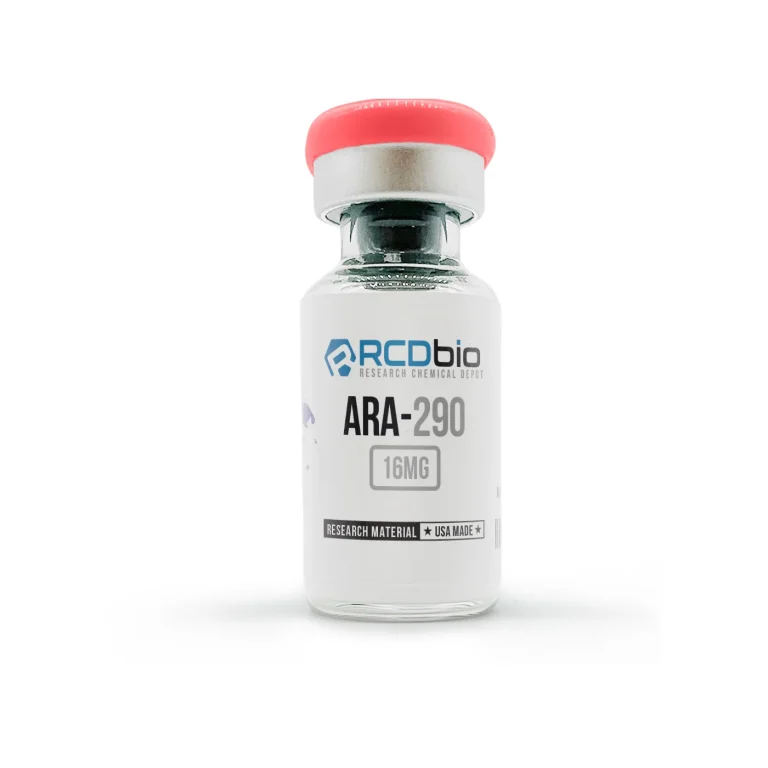
Description
What is ARA-290?
ARA-290, assigned the International Nonproprietary Name cibinetide, is a synthetic linear 11-amino acid peptidomimetic engineered from the aqueous-exposed surface of helix B in the tertiary structure of human erythropoietin (EPO). It was developed by Brines and Cerami at Araim Pharmaceuticals following the identification that EPO mediates two pharmacologically distinct activities through distinct receptor architectures: erythropoiesis, driven by the classical homodimeric EPO receptor (EPOR/EPOR), and tissue protection, driven by a heteromeric receptor complex composed of EPOR and the beta-common receptor (βcR, CD131) — designated the innate repair receptor (IRR). By restricting the peptide sequence to the helix-B surface domain, ARA-290 was engineered to retain selective affinity for the IRR while eliminating binding to the erythropoietic homodimeric receptor.
In research settings, ARA-290 is investigated as a selective IRR agonist in preclinical models and early clinical study designs examining neuroprotection, anti-inflammatory signaling, neuroimmune modulation, and tissue-protective pathway activation. The IRR complex is characterized as a context-restricted receptor that is selectively upregulated in injured or inflamed tissue, which has made the compound a subject of interest in models of small fiber neuropathy, metabolic dysregulation, and organ-level cytoprotection.
RCDbio synthetic ARA-290 is supplied as a lyophilized white to off-white powder in sealed research vials intended strictly for laboratory and research purposes. It is not approved by the Food and Drug Administration for use in this research-grade, non-pharmaceutical form. It is not a dietary supplement and is not intended for human consumption or therapeutic self-administration.
Chemical Properties
| Property | Detail |
| Product Type | Synthetic Linear Undecapeptide (EPO Helix-B Surface Peptide) |
| Product Name | ARA-290 (Cibinetide) |
| Application | Scientific / Research Use Only |
| CAS Number | 1208243-50-8 (free base) |
| Molar Mass | 1257.32 g/mol (free base, C₅₁H₈₄N₁₆O₂₁) |
| Chemical Formula | C₅₁H₈₄N₁₆O₂₁ |
| Sequence | pyroGlu-Glu-Gln-Leu-Glu-Arg-Ala-Leu-Asn-Ser-Ser (N-terminal pyroglutamate; free C-terminus) |
| IUPAC Name | (4S)-5-[[(2S)-5-amino-1-[[(2S)-1-[[(2S)-1-[[(2S)-1-[[(2S)-1-[[(2S)-1-[[(2S)-4-amino-1-[[(2S)-1-[[(1S)-1-carboxy-2-hydroxyethyl]amino]-3-hydroxy-1-oxopropan-2-yl]amino]-1,4-dioxobutan-2-yl]amino]-4-methyl-1-oxopentan-2-yl]amino]-1-oxopropan-2-yl]amino]-5-(diaminomethylideneamino)-1-oxopentan-2-yl]amino]-4-carboxy-1-oxobutan-2-yl]amino]-4-methyl-1-oxopentan-2-yl]amino]-1,5-dioxopentan-2-yl]amino]-5-oxo-4-[[(2S)-5-oxopyrrolidine-2-carbonyl]amino]pentanoic acid |
| Synonyms | Cibinetide (INN); pHBSP (pyroglutamate helix B surface peptide); developmental code ARA290 (no hyphen variant); UEQLERALNSS (single-letter sequence notation) |
| Physical Form | Lyophilized white to off-white powder |
| Solubility | Soluble in sterile water for injection or bacteriostatic water; also soluble in aqueous acetic acid (0.1–1% v/v); not dependent on organic co-solvents at research concentrations. No disulfide bridge; reducing agents do not affect structural integrity. |
| Storage (Lyophilized) | Store at −20°C in a sealed, light-protected container with desiccant; protect from moisture and repeated temperature fluctuations |
| Storage (Reconstituted) | Store at 4°C; use within 7–14 days of reconstitution; avoid repeated freeze-thaw cycles; discard any solution that appears turbid, discolored, or shows particulate matter |
| PubChem CID | 91810664 (free base) |
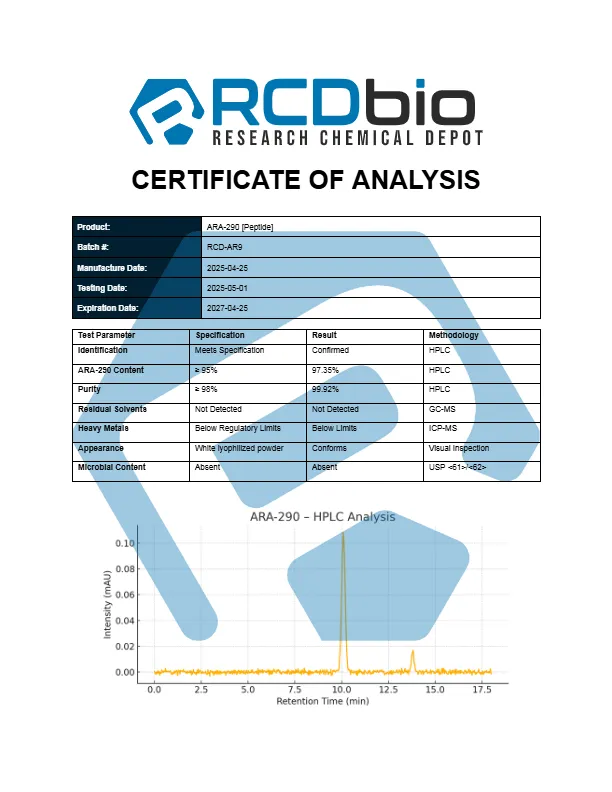
| Purity | ≥98% (HPLC verified, independent third-party laboratory analysis; COA available per batch) |
| WADA Status | ARA-290 does not appear by its developmental code name on the current WADA Prohibited List. However, as a peptide with EPO-receptor affinity, it may fall within the S2 Peptide Hormones, Growth Factors, Related Substances, and Mimetics category depending on its regulatory classification at the time of use. Researchers engaged in sport-adjacent studies should verify the current status at GlobalDRO.com before use. |
How Does ARA-290 Work?
ARA-290 exerts its characterized laboratory effects by selectively engaging the innate repair receptor (IRR), a heteromeric receptor complex assembled from the EPO receptor (EPOR) subunit and the beta-common receptor (βcR, CD131) — the shared signaling subunit also found in the GM-CSF, IL-3, and IL-5 receptor complexes. Unlike the homodimeric EPOR complex that drives red blood cell production, the IRR is selectively upregulated in injured, hypoxic, or inflamed tissue and is largely absent from constitutive expression in unstressed cells. This context-dependent upregulation is the structural basis for ARA-290’s characterization as a tissue-restricted rather than systemic agonist.
IRR-Mediated JAK2/STAT5 and PI3K/Akt Activation
In cell-based preparations and preclinical in vivo models, ARA-290 binding to the IRR has been characterized to initiate intracellular signaling cascades involving Janus kinase 2 (JAK2) phosphorylation and downstream activation of signal transducer and activator of transcription 5 (STAT5), as well as PI3K/Akt-mediated survival pathway engagement. Phosphorylation of Akt in stressed cell systems exposed to ARA-290 has been associated with inhibition of pro-apoptotic signaling and suppression of glycogen synthase kinase-3 (GSK-3) activation, a downstream effector implicated in both inflammatory amplification and cellular death pathways. These observations have been made across multiple stressed cell-type preparations including neuronal, endothelial, and islet cell models.
NF-κB Suppression and Pro-Inflammatory Cytokine Modulation
In inflammatory model systems, IRR activation by ARA-290 has been characterized to inhibit NF-κB nuclear translocation, a central transcriptional driver of pro-inflammatory cytokine gene expression. In rodent in vivo models and isolated cell preparations, this inhibition has been associated with reductions in TNF-α and IL-6 secretion at inflammatory foci. The immunomodulatory profile is described in the literature as distinct from broad immunosuppression: IRR-mediated signaling appears to attenuate excessive innate immune activation without broadly inhibiting effector immune responses. This characterization has been explored in experimental autoimmune encephalomyelitis (EAE) rodent models, murine colitis preparations, and lupus-prone MRL/lpr mouse models.
TRPV1 Antagonism and Nociceptive Pathway Modulation
In nociceptive signaling preparations, ARA-290 has been characterized to interact with the transient receptor potential vanilloid 1 (TRPV1) channel a peripheral nociceptor involved in pain signal transduction and neurogenic inflammation. In rodent pain model preparations, this TRPV1 interaction has been associated with mechanical allodynia attenuation independent of the IRR signaling axis, suggesting a dual mechanistic basis for ARA-290’s observed anti-nociceptive effects in experimental systems. The TRPV1-mediated pathway is considered an additional, complementary mechanism to the upstream JAK2/Akt cascade.
Small Fiber Nerve Regeneration Preclinical and Clinical Study Models
In preclinical neurotoxic and diabetic neuropathy models, ARA-290 has been investigated for intraepidermal nerve fiber (IENF) density restoration. Regrowth of small fiber nerve endings has been characterized following ARA-290 administration in toxin-induced and streptozotocin-diabetic rodent models, with proposed mechanisms involving IRR-dependent trophic support and anti-apoptotic signaling in peripheral sensory neurons. These preclinical observations formed the basis for subsequent investigational human study designs examining corneal nerve fiber density as a surrogate biomarker.
Key Research Findings
- IRR receptor characterization: EPOR/βcR (CD131) heterocomplex identified as the molecular mediator of EPO-derived tissue-protective signaling; ARA-290 engineered to selectively bind IRR without EPOR homodimer engagement, confirmed in cell-based and in vivo preparations. [Brines et al., PNAS, 2008]
- Neuropathic pain attenuation: IRR-dependent prevention of mechanical allodynia observed in peripheral nerve transection and inflammatory neuritis rodent models; spinal cord inflammatory marker reduction co-characterized. [Dahan et al., Mol Med, 2013]
- Small fiber neuropathy surrogate biomarkers: Increased corneal nerve fiber density and reduced SFNSL scores observed in a randomized double-blind pilot study of sarcoidosis patients with small fiber neuropathy symptoms; no safety concerns raised by clinical or laboratory assessments. [Heij et al., Mol Med, 2012]
- Metabolic and neuropathic endpoints: Improved neuropathic symptom scores and HbA1c-independent metabolic biomarker changes observed in a Phase 2 investigational study of type 2 diabetes subjects; corneal confocal microscopy used as small fiber density biomarker. [Brines et al., Mol Med, 2014/2015]
- Endothelial progenitor cell response: ARA-290 characterized to enhance proliferation, migration, and H₂O₂-induced apoptosis resistance in endothelial colony-forming cell (ECFC) preparations; improved homing and post-transplant vascular density observed in murine critical limb ischemia models. [Hache et al., Shock, 2016]
All findings listed above are derived from preclinical or in vitro data except where explicitly noted as Phase 2 investigational study observations. No conclusions regarding human therapeutic efficacy can be drawn from these observations. These findings do not constitute evidence of safety or efficacy in any human condition or organism.
What are the Potential Research Applications of ARA-290?
Innate Repair Receptor (IRR) Pharmacology
ARA-290 is the primary reference tool compound in laboratory investigations characterizing the EPOR/βcR (CD131) heterocomplex. It is employed in radioligand competition assays, receptor co-immunoprecipitation protocols, and downstream pathway reporter systems to distinguish IRR-mediated signaling from classical EPOR homodimer-mediated erythropoietic signaling. Its well-characterized receptor selectivity makes it a standard probe in studies establishing the mechanistic basis for EPO’s tissue-protective actions independent of erythropoiesis.
Peripheral Neuropathy and Small Fiber Nerve Biology
In experimental models of peripheral neuropathy — including streptozotocin-induced diabetic neuropathy, chemotherapy-induced peripheral neuropathy, and toxin-mediated small fiber degeneration in rodent models — ARA-290 is investigated for its effects on intraepidermal nerve fiber density, sensory neuron survival, and nociceptive biomarker endpoints. It is used as a tool compound to probe the contribution of IRR-mediated trophic support to peripheral nerve fiber regeneration and maintenance.
Neuroimmune Signaling and Inflammatory Biology
In experimental autoimmune and inflammatory model systems, ARA-290 is utilized to investigate the intersection of innate immune activation and neurological tissue integrity. Studies employing EAE models, colitis preparations, and cytokine-challenged isolated tissue have used ARA-290 to characterize the contribution of IRR-mediated NF-κB suppression and JAK2/Akt activation to neuroimmune balance. It is also used in isolated islet cell preparations to probe cytoprotective signaling under inflammatory stress conditions relevant to pancreatic islet biology research.
Endothelial Biology and Vascular Research
ARA-290 is investigated in vascular research contexts for its characterized effects on endothelial colony-forming cell (ECFC) function, including proliferation, migration, and survival under oxidative or inflammatory stress. In murine ischemia models, it has been used as a probe to examine the relationship between IRR activation, endothelial progenitor cell homing, and post-ischemic vascular restoration. These applications position it as a tool compound in translational vascular biology research.
Cytoprotection and Organ-Level Stress Response
Research investigating organ-level responses to ischemia-reperfusion injury, hypoxic stress, and burn-model secondary tissue injury has employed ARA-290 as a selective IRR agonist to dissect the tissue-protective arm of EPO-related signaling from hematologic effects. This includes renal, cardiac, retinal, and cutaneous injury model systems in rodent preparations.
These are observed in preclinical and in vitro contexts only and do not constitute claims of efficacy or safety in any organism.
What are the Potential Side Effects of ARA-290?
- Injection site reactions (mild erythema and transient local discomfort) were reported at low frequency in Phase 2 investigational study populations; no dose-limiting local toxicity was characterized at doses evaluated in those study designs
- No hematologic effects — specifically no changes in hemoglobin, hematocrit, or reticulocyte counts — were observed in preclinical rodent models or Phase 2 study designs at doses investigated; this reflects the engineered absence of EPOR homodimer engagement
- Transient cardiovascular parameter changes (blood pressure, heart rate) have not been characterized as a consistent finding in preclinical rodent models at research-relevant doses; however, EPO-derived signaling on cardiovascular tissue is a recognized monitoring variable in study designs utilizing EPO-related compounds
- In EAE rodent models, dose-dependent neurological severity modulation was observed, consistent with immunomodulatory activity at higher doses (70 µg/kg i.p. in rodent models) versus partial effects at lower doses; findings are not uniform across model systems or species
- No acute hepatotoxicity, nephrotoxicity, or systemic organ-level toxicity has been characterized in published preclinical data at research-relevant concentrations; long-term toxicology data for chronic exposure in animal models is limited in the published literature
No human safety or tolerability data pertaining to research-grade ARA-290 supplied in lyophilized powder form has been established. The Phase 2 investigational data referenced herein reflects pharmaceutical-grade, controlled-trial formulations and should not be extrapolated to research-grade material. These observations are derived from experimental systems and should not be extrapolated to human or animal outcomes.
Risk & Handling
Handling Precautions
ARA-290 lyophilized powder should be handled by trained laboratory personnel only. Standard peptide handling precautions apply: nitrile gloves, laboratory coat, and eye protection at minimum. Reconstitution of lyophilized powder should be performed with care to avoid aerosol generation; use of a biosafety cabinet is recommended when working with powdered material. ARA-290 does not contain a disulfide bridge and is not sensitive to reducing agents; however, all peptide reconstitution operations should follow institutional SOPs for bioactive peptide handling. Avoid repeated freeze-thaw cycling of reconstituted solutions.
Exposure Risks
Risk Tier: MODERATE
ARA-290 is a pharmacologically active peptide with characterized receptor-level activity at the EPOR/βcR IRR complex. Published Phase 2 investigational safety data from sarcoidosis and type 2 diabetes study designs at 4 mg/day subcutaneous dosing reported no serious adverse events attributable to the compound and no hematologic effects. At preclinical model doses, no acute lethality or dose-limiting organ toxicity has been characterized in the published literature. The compound’s short plasma half-life (estimated at minutes in aqueous systems, consistent with other short linear peptides lacking stabilizing modifications) limits systemic exposure duration following incidental contact. No human safety data has been established for research-grade lyophilized ARA-290 supplied in non-pharmaceutical form. Researchers should exercise caution appropriate to handling a potent, biologically active receptor agonist with cytokine-pathway activity.
Storage
- Lyophilized form: Store at −20°C in a sealed, light-protected container with desiccant; minimize exposure to ambient humidity
- Reconstituted form: Store at 4°C; use within 7–14 days of reconstitution; label reconstitution date and time
- Avoid repeated freeze-thaw cycles; each cycle risks progressive loss of peptide activity
- No reducing agent sensitivity (no disulfide bridge); however, avoid prolonged exposure to strongly oxidizing conditions
- Discard any reconstituted solution that appears turbid, discolored, or shows visible particulate matter
FAQs
Q: What is ARA-290 and what is it investigated for in research settings? A: ARA-290 (cibinetide) is a synthetic 11-amino acid linear peptide engineered from the helix-B surface domain of human erythropoietin (EPO). In laboratory settings, it is investigated as a selective agonist of the innate repair receptor (IRR) — the EPOR/βcR (CD131) heteromeric complex — with research applications spanning peripheral neuropathy models, neuroimmune signaling, endothelial biology, and organ-level cytoprotection. It does not engage the classical homodimeric EPOR that drives red blood cell production. It is not approved for human use and is supplied by RCDbio strictly for laboratory and research purposes.
Q: What is the plasma half-life of ARA-290 in preclinical models? A: ARA-290 is a short linear peptide without stabilizing modifications (no PEGylation, no disulfide bridge, no N-terminal capping other than the naturally cyclized pyroglutamate). Its plasma half-life in aqueous systems and rodent models is characterized as short — estimated in the range of minutes — consistent with proteolytic susceptibility typical of unmodified peptides in plasma. Despite this short circulating half-life, preclinical models have characterized sustained downstream effects attributed to persistent IRR-mediated intracellular signaling following receptor engagement. These figures are derived from laboratory and preclinical model data and do not represent human pharmacokinetic data for research-grade material.
Q: How should ARA-290 be stored to maintain stability? A: Lyophilized ARA-290 should be stored at −20°C in a sealed, desiccated, light-protected container. Reconstituted solutions should be stored at 4°C and used within 7–14 days. Repeated freeze-thaw cycling should be avoided to maintain peptide integrity. ARA-290 does not contain a disulfide bridge and is not sensitive to reducing agents, but should be protected from strong oxidizing conditions. Turbid or discolored solutions should be discarded.
Q: What toxicity observations have been reported in preclinical studies of ARA-290? A: In published preclinical rodent model data, ARA-290 has not been characterized as acutely toxic at research-relevant concentrations. No dose-limiting hepatotoxicity, nephrotoxicity, or hematologic effects have been reported. At high doses in EAE models (70 µg/kg i.p. in rats), immunomodulatory effects — including delayed neurological symptom onset — were observed as expected pharmacological outcomes. Phase 2 investigational study safety assessments in sarcoidosis and type 2 diabetes patient populations reported no serious adverse events; however, those observations reflect pharmaceutical-grade formulations under clinical trial conditions and are not applicable to research-grade lyophilized powder. Long-term chronic toxicity data in animal models is limited in the published literature.
Q: What is ARA-290 typically reconstituted with in laboratory research? A: In laboratory research, ARA-290 lyophilized powder is typically reconstituted with sterile water for injection, bacteriostatic water (0.9% benzyl alcohol in water), or 0.1–1% aqueous acetic acid. The choice of diluent depends on the experimental system and downstream application (e.g., cell culture vs. in vivo rodent administration). Unlike disulfide-containing peptides, ARA-290 does not require reducing agent-free conditions. Researchers should consult their institutional protocols and COA documentation for guidance specific to the supplied batch.
Q: What distinguishes ARA-290’s receptor profile from native erythropoietin? A: Native EPO activates two distinct receptor architectures: the classical homodimeric EPOR (EPOR/EPOR), which drives erythropoiesis and carries associated risks of elevated hematocrit and thromboembolic complications in clinical use, and the heteromeric innate repair receptor (IRR, EPOR/βcR), which mediates tissue-protective, anti-inflammatory, and anti-apoptotic signaling. ARA-290 was rationally engineered to retain binding affinity only for the IRR by restricting the sequence to the helix-B surface of EPO — the region not involved in homodimeric EPOR engagement. This receptor selectivity has been confirmed in multiple cell-based and in vivo model systems and is the structural basis for ARA-290’s characterization as a nonerythropoietic EPO derivative.
Q: Is ARA-290 subject to WADA regulation in sport-adjacent research contexts? A: ARA-290 does not appear by name on the WADA Prohibited List as of currently available information. However, as a peptide derived from erythropoietin with EPO receptor affinity, it may fall under the S2 Peptide Hormones, Growth Factors, Related Substances, and Mimetics category depending on jurisdictional interpretation. Researchers engaged in any study design adjacent to competitive sport or anti-doping research should verify the current regulatory status at GlobalDRO.com before initiating use.
Related Research Compounds
BPC-157 [Peptide] — A synthetic pentadecapeptide fragment of body protection compound investigated in preclinical models for angiogenic signaling, nitric oxide pathway modulation, and peripheral nerve cytoprotection; used in complementary laboratory investigations of tissue-repair peptide pharmacology where IRR-independent regenerative mechanisms are the subject of study.
VIP (Vasoactive Intestinal Peptide) [Peptide] — A 28-amino acid neuropeptide characterized as an immunomodulatory and neuroprotective agent in preclinical models via VPAC1/VPAC2 receptor systems; investigated alongside ARA-290 in research contexts examining anti-inflammatory peptide signaling diversity and neuroimmune pathway crosstalk.
KPV (Lysine-Proline-Valine) [Peptide] — A melanocortin receptor-active tripeptide investigated in rodent models for anti-inflammatory and mucosal cytoprotective effects via MC1R signaling; used in comparative laboratory research on receptor-mediated innate immune modulation by short synthetic peptides.
References
- Brines M, Patel NS, Villa P, et al. Nonerythropoietic, tissue-protective peptides derived from the tertiary structure of erythropoietin. Proc Natl Acad Sci U S A. 2008;105(31):10925–10930. https://pubmed.ncbi.nlm.nih.gov/18676614/
- Brines M, Cerami A. The receptor that tames the innate immune response. Mol Med. 2012;18:486–496. https://pubmed.ncbi.nlm.nih.gov/22183892/
- Heij L, Niesters M, Swartjes M, et al. Safety and efficacy of ARA 290 in sarcoidosis patients with symptoms of small fiber neuropathy: a randomized, double-blind pilot study. Mol Med. 2012;18:1430–1436. https://pmc.ncbi.nlm.nih.gov/articles/PMC3563705/
- Dahan A, Dunne A, Swartjes M, et al. ARA 290 improves symptoms in patients with sarcoidosis-associated small nerve fiber loss and increases corneal nerve fiber density. Mol Med. 2013;19:334–345. https://pubmed.ncbi.nlm.nih.gov/24136731/
- Culver DA, Dahan A, Bajorunas D, et al. Cibinetide improves corneal nerve fiber abundance in patients with sarcoidosis-associated small nerve fiber loss and neuropathic pain. Invest Ophthalmol Vis Sci. 2017;58(6):BIO52–BIO60. https://pubmed.ncbi.nlm.nih.gov/28475703/
Disclaimer
ARA-290 is exclusively for laboratory research purposes. RCDbio products are not intended to diagnose, prevent, treat, or cure any disease or medical condition.
The Food and Drug Administration has not evaluated the statements on our website. This product is not approved for human or veterinary use. Researchers must comply with all applicable local, state, and federal laws and regulations governing the purchase and use of research compounds. By purchasing, you agree to our Terms and Conditions. RCDbio reserves the right to refuse sales to unauthorized individuals.
ATTENTION: All RCDbio products are strictly for LABORATORY AND RESEARCH PURPOSES ONLY. They are not intended for human consumption, veterinary use, or any other non-research application. For queries, complaints, or support, contact support@rcdbio.co
Reviews
There are no reviews yet