

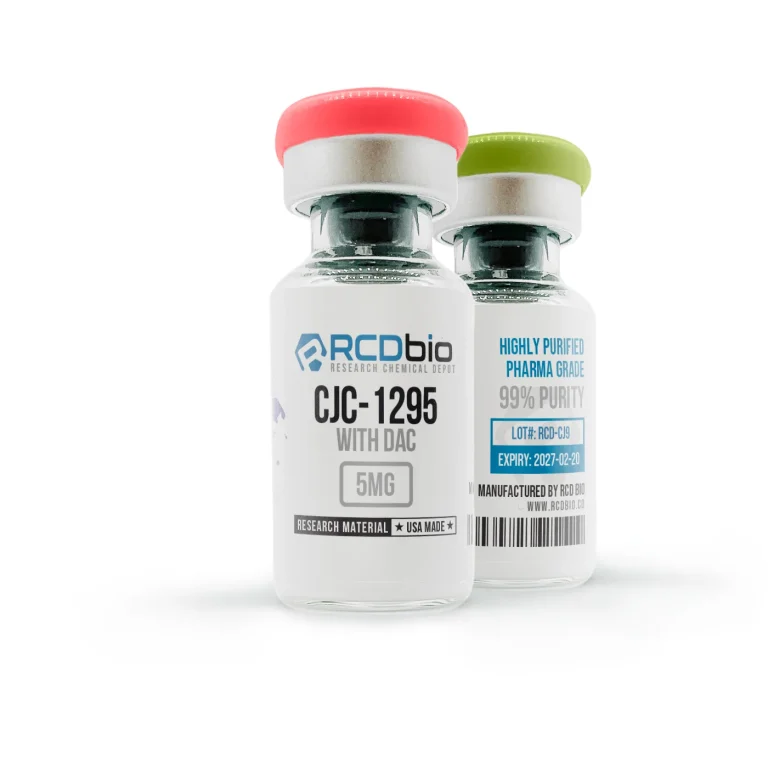
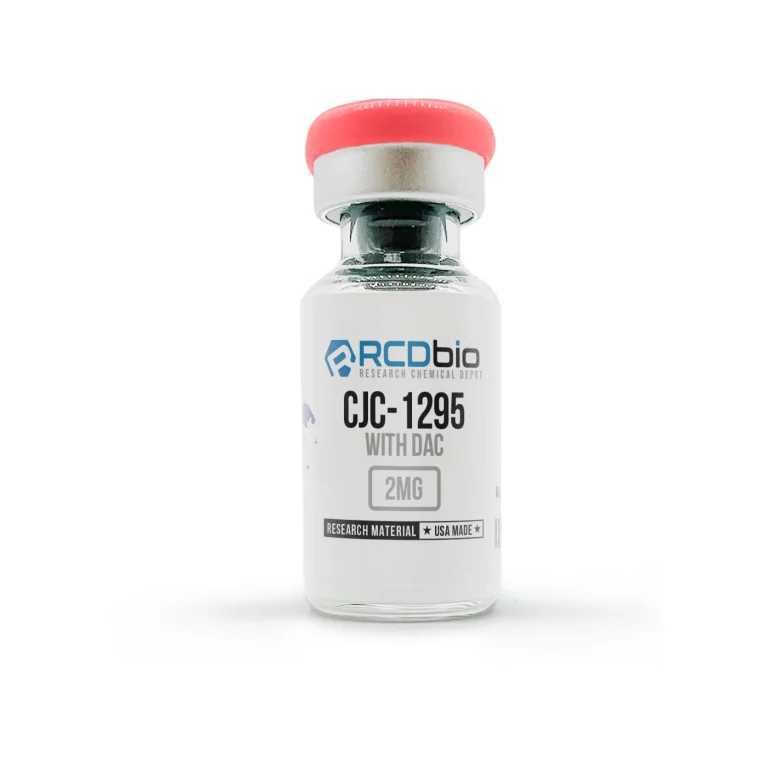
Description
What is CJC-1295 with DAC?
CJC-1295 with DAC is a synthetic 29-amino acid analogue of human growth hormone-releasing hormone (hGHRH 1-29), engineered by ConjuChem Biotechnologies (Montreal, Canada) for extended plasma half-life through covalent albumin binding. The compound’s name derives from its two structural components: the core GHRH peptide sequence (CJC-1295) and the Drug Affinity Complex (DAC) technology — a maleimidopropionic acid moiety attached to a lysine residue at the C-terminus that forms stable covalent linkages with free thiol groups on endogenous plasma proteins, principally serum albumin, upon subcutaneous injection.
The core CJC-1295 sequence incorporates four amino acid substitutions relative to native hGHRH 1-29 — at positions 2 (Ala→D-Ala), 8 (Gln→Ala), 15 (Ala→Ala), and 27 (Met→Nle or similar modification depending on synthesis specification) — designed to increase resistance to proteolytic inactivation by dipeptidyl peptidase IV (DPP-IV) and other plasma proteases. The DAC moiety then couples the peptide covalently to circulating albumin, extending its effective half-life to approximately 5.8–8.1 days in human clinical pharmacokinetic studies — comparable to albumin’s own half-life — enabling once-weekly or less frequent dosing.
CJC-1295 with DAC has been investigated in preclinical rodent models and Phase 1/2 human clinical studies for sustained stimulation of growth hormone (GH) and insulin-like growth factor-1 (IGF-1) axis signalling. Commercial pharmaceutical development was discontinued following a clinical trial participant death — determined to be unrelated to the study drug — and the compound has not received FDA approval for any indication. Research-grade CJC-1295 with DAC is not a pharmaceutical product and is not intended for human consumption or therapeutic self-administration. All RCDbio research compounds are supplied strictly for laboratory and research purposes only.
Chemical Properties
| Property | Detail |
| Product Type | Synthetic Long-Acting GHRH Analogue Peptide (DAC-conjugated albumin-binding) |
| Product Name | CJC-1295 with DAC |
| Application | Scientific / Research Use Only |
| CAS Number | 446262-90-4 |
| Molar Mass | 3647.250 g/mol |
| Chemical Formula | C165H269N47O46 |
| PubChem CID | 56841945 |
| Amino Acid Count | 29 amino acids (hGHRH 1-29 backbone; modified at positions 2, 8, 15, 27 for DPP-IV resistance) |
| DAC Moiety | Maleimidopropionic acid at the C-terminal lysine forms a covalent thioether bond with albumin Cys34 |
| Half-Life | 5.8–8.1 days (human clinical pharmacokinetics; albumin-conjugated form); endogenous GHRH half-life <7 minutes by contrast |
| Synonyms | CJC-1295 DAC; hGRF1-29-albumin bioconjugate; DAC:GRF |
| Physical Form | Lyophilized white to off-white powder |
| Solubility | Soluble in sterile water and PBS; compatible with standard peptide reconstitution buffers |
| Storage (Lyophilized) | −20°C; sealed container; protected from light and moisture |
| Storage (Reconstituted) | 4°C; use within 48–72 hours; avoid repeated freeze-thaw cycles |
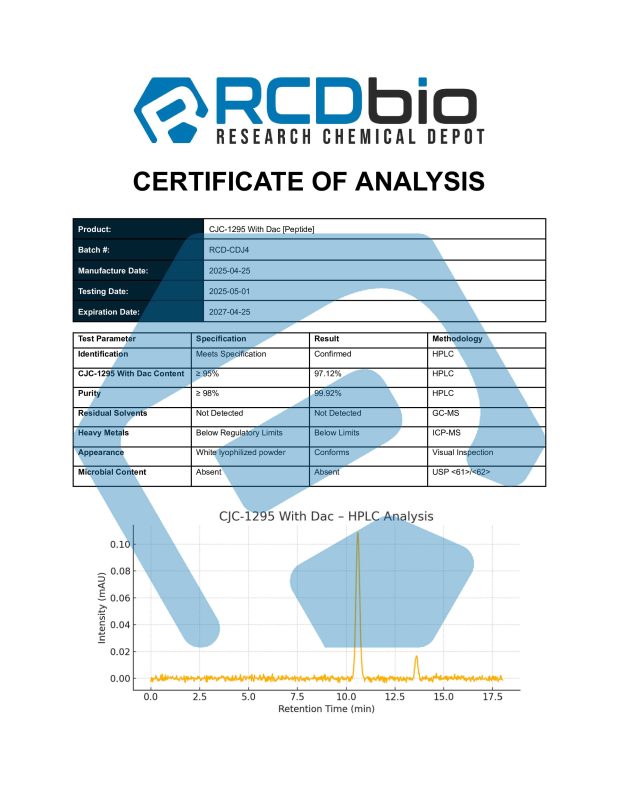
| Purity | ≥98% (HPLC verified, independent third-party laboratory analysis; COA available per batch) |
| WADA Status | Prohibited at all times under S2 (Peptide Hormones, Growth Factors, Related Substances and Mimetics — GHRH and GHRH analogues) of the 2026 WADA Prohibited List. Researchers in sport-adjacent studies must verify the current status at GlobalDRO.com before use. |
How Does CJC-1295 with DAC Work?
CJC-1295 with DAC exerts its effects through two sequential mechanisms: albumin binding via the DAC moiety, which extends systemic exposure, followed by sustained activation of the GHRH receptor (GHRHR) on pituitary somatotroph cells, which stimulates GH synthesis and pulsatile secretion.
DAC Technology and Albumin Covalent Binding
Upon subcutaneous injection, the maleimidopropionic acid group of the DAC moiety undergoes a selective Michael addition reaction with the free thiol group of Cys34 on circulating serum albumin. This covalent thioether bond is highly stable under physiological conditions and effectively converts CJC-1295 into an albumin-bound form with a half-life matching that of albumin (~5.8–8.1 days in human studies) [Teichman et al., 2006]. This mechanism is conceptually analogous to fatty acid conjugation strategies used in semaglutide and Tirzepatide, but uses direct covalent bonding rather than non-covalent binding. The albumin-conjugated CJC-1295 serves as a slow-release reservoir, gradually releasing or presenting the active GHRH moiety to pituitary receptors over an extended period.
GHRH Receptor (GHRHR) Activation and cAMP Pathway
The CJC-1295 peptide component binds to and activates GHRH receptors on somatotroph cells of the anterior pituitary gland. GHRHR is a seven-transmembrane Gαs-coupled GPCR; receptor activation initiates adenylyl cyclase stimulation, generating elevated intracellular cyclic AMP (cAMP) concentrations and downstream protein kinase A (PKA) activation [Jetté et al., 2005]. This cascade promotes transcription of the GH1 gene and triggers pulsatile release of stored growth hormone granules from somatotroph secretory vesicles.
Growth Hormone Axis Stimulation
GH released from somatotroph cells acts directly on peripheral tissues and stimulates hepatic production of insulin-like growth factor-1 (IGF-1), the primary mediator of GH’s anabolic and growth-promoting effects in peripheral tissues. In the Phase 1/2 clinical study by Teichman et al. (2006), a single subcutaneous injection of CJC-1295 produced dose-dependent 2- to 10-fold increases in mean plasma GH concentrations sustained for 6 or more days, and 1.5- to 3-fold increases in mean plasma IGF-1 concentrations sustained for 9–11 days [Teichman et al., 2006]. Multiple dose administration maintained IGF-1 levels above baseline for up to 28 days, demonstrating cumulative effects.
Preservation of Pulsatile GH Secretion
A key mechanistic feature of CJC-1295 in clinical studies is that it amplifies GH pulse amplitude without abolishing the natural pulsatile secretory pattern — in contrast to recombinant GH administration, which suppresses endogenous pulsatile GH release through feedback mechanisms. This preservation of pulsatile secretion is considered physiologically and pharmacologically distinct from exogenous GH administration in research contexts [Teichman et al., 2006].
Key Research Findings
In preclinical and clinical research contexts, CJC-1295 with DAC has been associated with the following observations:
- Sustained GH stimulation: Single injection produced 2- to 10-fold increases in plasma GH sustained for 6+ days in healthy adult subjects in Phase 1/2 clinical studies; cumulative effect observed with multiple doses [Teichman et al., 2006].
- IGF-1 elevation: 1.5- to 3-fold increases in mean plasma IGF-1 sustained for 9–11 days following single injection; maintained above baseline for up to 28 days with multiple doses [Teichman et al., 2006].
- Half-life extension: Estimated half-life of 5.8–8.1 days in human pharmacokinetic studies, compared to <7 minutes for endogenous GHRH; achieved via covalent albumin binding through DAC maleimide technology [Teichman et al., 2006].
- GHRHKO mouse model: Daily CJC-1295 administration normalised body weight, body length, and somatotroph cell function in GHRH knockout mice, demonstrating functional GHRHR engagement and downstream GH axis restoration in preclinical models.
- Pulsatile GH preservation: GH secretory pulse amplitude enhanced without suppression of natural pulsatile release pattern in clinical pharmacodynamic studies — mechanistically distinct from recombinant GH administration.
All findings listed above are derived from preclinical in vivo rodent model data and Phase 1/2 human clinical trial data. CJC-1295 with DAC has not received FDA approval for any indication. Clinical development was discontinued. These observations do not constitute evidence of safety or efficacy for research-grade material.
What are the Potential Research Applications of CJC-1295 with DAC?
In controlled laboratory and clinical research environments, CJC-1295 with DAC has been investigated for the following research applications. These are observed in preclinical and clinical trial contexts and do not constitute claims of efficacy or safety for research-grade material outside approved protocols.
GHRH Receptor Pharmacology and GH Axis Studies CJC-1295 with DAC is employed as a long-acting GHRHR agonist reference compound in studies characterising somatotroph cell receptor activation, cAMP/PKA signalling cascades, and GH secretion dynamics in isolated pituitary cell preparations and rodent in vivo models. Its extended half-life enables sustained receptor engagement protocols not achievable with short-acting GHRH peptides.
GH Deficiency and Somatotroph Function Research In GHRH knockout mouse models and isolated somatotroph cell preparations, CJC-1295 with DAC is investigated for its capacity to restore GH axis function under conditions of GHRH deficiency. Research examines somatotroph cell proliferation, GH1 gene transcription, and IGF-1 secretion restoration in GH-deficient preclinical systems.
IGF-1 Axis and Downstream Signalling Research In cell-based and rodent in vivo systems, CJC-1295 with DAC is used to examine IGF-1 pathway activation, including IGF-1 receptor (IGF-1R) signalling cascades, PI3K/AKT pathway engagement, and downstream anabolic signalling in muscle, bone, and hepatic tissue preparations.
Albumin Conjugation and Drug Delivery Platform Research CJC-1295 with DAC serves as a model compound for investigating maleimide-based covalent albumin conjugation technology (DAC technology) in pharmacokinetic research. Studies examine the chemistry of maleimide-thiol Michael addition at albumin Cys34, conjugate stability under physiological conditions, and the release kinetics of bioactive peptide from albumin-conjugated forms.
Comparative GHRH Analogue Pharmacology CJC-1295 with DAC is employed in comparative studies alongside short-acting GHRH analogues (Sermorelin, Modified GRF 1-29 / CJC-1295 without DAC) and Tesamorelin to characterise how albumin conjugation alters receptor engagement duration, GH pulse amplitude, cumulative IGF-1 effects, and pulsatile secretion profiles in preclinical and clinical models.
What are the Potential Side Effects of CJC-1295 with DAC?
The following observations are derived from Phase 1/2 clinical trial data (Teichman et al., 2006) and preclinical studies. Research-grade material adverse effects have not been independently characterised.
- Water retention and fluid-related symptoms were reported in a subset of clinical trial participants, consistent with GH axis activation and IGF-1 elevation effects on renal sodium retention
- Injection site reactions (erythema, induration) were reported at low frequency in clinical trial participants; mild and transient
- Headache reported in a subset of clinical trial participants following a single injection; classified as mild to moderate
- Nausea and flushing were reported at low frequency, consistent with GH secretagogue class pharmacology
- No serious adverse reactions were reported in clinical trial participants at doses of 30 or 60 μg/kg; one trial participant’s death was determined to be unrelated to the study drug
- Sustained IGF-1 elevation over extended periods carries theoretical risks consistent with GH axis overstimulation, including potential effects on glucose homeostasis, cell proliferation pathways, and cardiomegaly in long-term exposure models; long-term safety data in humans are absent
- No human safety or tolerability data have been established for research-grade CJC-1295 with DAC outside approved clinical trial contexts. These observations are derived from pharmaceutical-grade formulation trial data and should not be directly extrapolated to research-grade material.
Risk & Handling
Handling Precautions
CJC-1295 with DAC should only be handled by trained laboratory personnel familiar with research-grade peptide hormones and DAC-conjugated compounds. Appropriate personal protective equipment is required: nitrile gloves, a laboratory coat, and eye protection at a minimum. When working with lyophilized powder, use within a laminar flow cabinet or a clean area. Avoid aerosol generation during reconstitution. The maleimide group of the DAC moiety may react with free thiols in laboratory buffers or biological media — avoid DTT, β-mercaptoethanol, glutathione-containing buffers, or other thiol-containing reagents in reconstitution, storage, or assay systems, as these will disrupt the DAC functionality and alter the compound’s albumin-binding properties.
Exposure Risks
Risk Tier: MODERATE
CJC-1295 with DAC is a potent GHRH receptor agonist with well-characterised pharmacological activity on the GH/IGF-1 axis. Accidental systemic exposure could produce sustained GH and IGF-1 elevation lasting days due to the albumin-binding half-life extension. No human safety data has been established for research-grade material outside clinical trial contexts. Researchers should exercise caution appropriate to handling a potent, long-acting endocrine-active research peptide.
Storage
- Lyophilized form: Store at −20°C in original sealed, light-protected container with desiccant
- Reconstituted form: Store at 4°C; use within 48–72 hours of reconstitution
- Do not subject to repeated freeze-thaw cycles; both the peptide backbone and the DAC maleimide moiety integrity may be compromised
- Avoid all thiol-containing buffers, reagents, and media in reconstitution or assay systems; these will react with the maleimide group and abolish albumin-binding functionality
- Protect from prolonged light exposure; store away from oxidising conditions
Frequently Asked Questions
Q: What is CJC-1295 with DAC, and what is it investigated for in research? A: CJC-1295 with DAC is a synthetic 29-amino acid GHRH analogue incorporating a Drug Affinity Complex (DAC) maleimidopropionic acid moiety that covalently binds serum albumin, extending its half-life to 5.8–8.1 days in human pharmacokinetic studies. It is investigated in preclinical and clinical research contexts for sustained GHRH receptor activation, growth hormone and IGF-1 axis stimulation, and somatotroph cell function research. It is not approved by the FDA and is intended strictly for laboratory and research purposes.
Q: What is the difference between CJC-1295 with DAC and CJC-1295 without DAC (Modified GRF 1-29)? A: CJC-1295 without DAC (also called Modified GRF 1-29 or Mod GRF 1-29) is the same core 29-amino acid GHRH analogue with four amino acid substitutions for DPP-IV resistance, but without the maleimidopropionic acid DAC moiety. Without DAC, the peptide has a half-life of approximately 30 minutes, produces short GH pulses, and does not achieve sustained IGF-1 elevation. CJC-1295 with DAC adds covalent albumin binding, extending half-life to 5.8–8.1 days and enabling sustained GH and IGF-1 elevation for days to weeks after a single dose — a fundamentally different pharmacokinetic and pharmacodynamic profile.
Q: How does the DAC maleimide technology work? A: The Drug Affinity Complex (DAC) is a maleimidopropionic acid group attached to a C-terminal lysine on the CJC-1295 peptide. Upon subcutaneous injection, the maleimide undergoes a selective Michael addition reaction with the free thiol group of Cys34 on circulating serum albumin, forming a stable covalent thioether bond under physiological conditions. This converts CJC-1295 into an albumin-conjugated form with a half-life matching albumin’s (~5.8–8.1 days). Thiol-containing reagents (DTT, β-mercaptoethanol, glutathione) must be excluded from all reconstitution and assay buffers, as they will consume the maleimide group and prevent albumin conjugation.
Q: Is CJC-1295 with DAC FDA-approved? A: No. CJC-1295 with DAC was investigated in Phase 1/2 clinical trials by ConjuChem Biotechnologies, demonstrating sustained GH and IGF-1 elevation in healthy adults. Commercial pharmaceutical development was subsequently discontinued. No FDA approval has been granted for any indication. Research-grade CJC-1295 with DAC is not a pharmaceutical product and is not approved for human use.
Q: What were the key Phase 2 clinical findings for CJC-1295 with DAC? A: In the Phase 1/2 randomised, double-blind, placebo-controlled clinical study (Teichman et al., 2006, PMID 16352683), single subcutaneous injections produced dose-dependent 2- to 10-fold increases in plasma GH sustained for 6+ days, and 1.5- to 3-fold increases in plasma IGF-1 sustained for 9–11 days. Multiple doses maintained IGF-1 above baseline for up to 28 days. The half-life was estimated at 5.8–8.1 days. The compound was well tolerated at 30–60 μg/kg doses. No serious adverse reactions were reported.
Q: How should CJC-1295 with DAC be stored? A: Lyophilized CJC-1295 with DAC should be stored at −20°C in a sealed, light-protected container with desiccant. Once reconstituted, store at 4°C and use within 48–72 hours. Critically, avoid all thiol-containing buffers and reagents (DTT, β-mercaptoethanol, glutathione, cysteine) in reconstitution or downstream assay systems — these will react with the DAC maleimide group. Repeated freeze-thaw cycles should be avoided.
Q: What is CJC-1295 with DAC’s WADA status? A: CJC-1295 is explicitly prohibited at all times under S2 (Peptide Hormones, Growth Factors, Related Substances and Mimetics — GHRH analogues category) of the 2026 WADA Prohibited List. It is among the named GHRH analogues alongside Sermorelin and Tesamorelin. Researchers in sport-adjacent studies must verify the current status at GlobalDRO.com before use.
Related Research Compounds
Researchers investigating CJC-1295 with DAC may also be interested in the following compounds currently available for laboratory research at RCDbio:
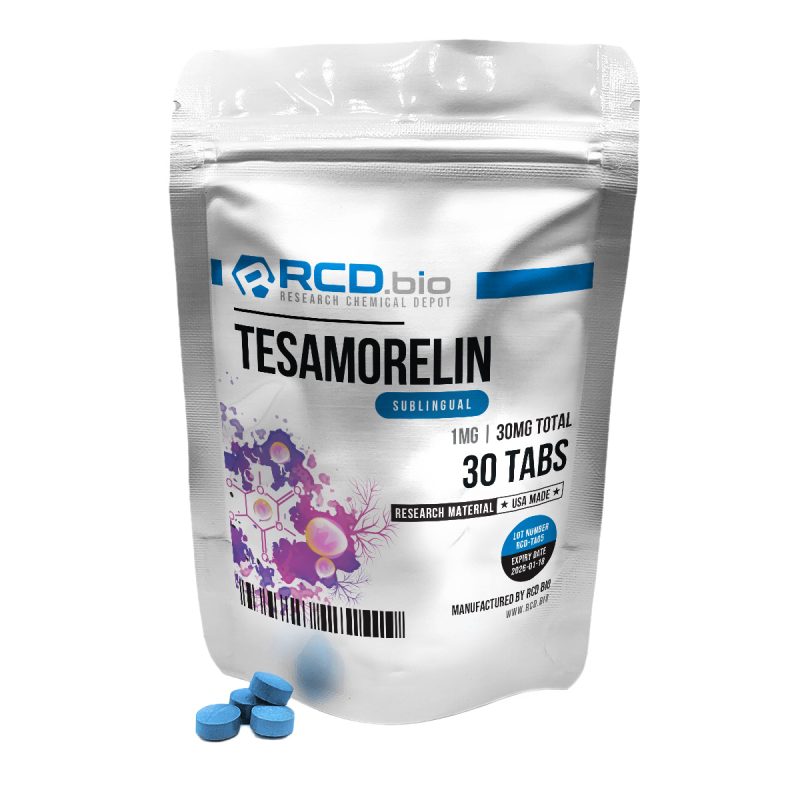
- Tesamorelin Nasal Spray — An FDA-approved GHRH analogue (Egrifta) with 44 amino acids and a trans-3-hexenoic acid N-terminal modification; the primary clinically validated GHRH analogue for comparative GH axis research alongside CJC-1295.
- Sermorelin — A 29-amino acid GHRH 1-29 analogue without the DAC modification; provides short-acting GHRH receptor stimulation as the primary mechanistic comparator for understanding DAC’s pharmacokinetic contribution in head-to-head research protocols.
- Ipamorelin — A selective GH secretagogue peptide acting via the ghrelin/GHS-R1a receptor pathway; commonly studied in combination with CJC-1295 DAC in preclinical models to characterise GHRH-independent vs GHRH-dependent GH secretion pathway interactions.
All products listed are for laboratory and research purposes only.
References
- Teichman, S. L., Neale, A., Lawrence, B., Gagnon, C., Castaigne, J. P., & Frohman, L. A. (2006). Prolonged Stimulation of Growth Hormone (GH) and Insulin-Like Growth Factor I Secretion by CJC-1295, a Long-Acting Analog of GH-Releasing Hormone, in Healthy Adults. Journal of Clinical Endocrinology & Metabolism, 91(3), 799–805. https://pubmed.ncbi.nlm.nih.gov/16352683/
- Jetté, L., Léger, R., Thibaudeau, K., Benquet, C., Robitaille, M., Pellerin, I., Paradis, V., van Wyk, P., Pham, K., & Bridon, D. P. (2005). Human Growth Hormone-Releasing Factor (hGRF)1-29-Albumin Bioconjugates Activate the GRF Receptor on the Anterior Pituitary in Rats: Identification of CJC-1295 as a Long-Lasting GRF Analog. Endocrinology, 146(7), 3052–3058. https://pubmed.ncbi.nlm.nih.gov/15817669/
- Alba, M., Fintini, D., Sagazio, A., Lawrence, B., Castaigne, J. P., Frohman, L. A., & Salvatori, R. (2006). Once-daily administration of CJC-1295, a long-acting growth hormone-releasing hormone (GHRH) analog, normalizes growth in the GHRH knockout mouse. American Journal of Physiology — Endocrinology and Metabolism, 291(6), E1290–E1294. https://pubmed.ncbi.nlm.nih.gov/16822960/
- Sackmann-Sala, L., Ding, J., Frohman, L. A., & Kopchick, J. J. (2009). Activation of the GH/IGF-1 axis by CJC-1295, a long-acting GHRH analog, results in serum protein profile changes in normal adult subjects. Growth Hormone & IGF Research, 19(6), 471–477. https://pubmed.ncbi.nlm.nih.gov/19540783/
Disclaimer
CJC-1295 with DAC is exclusively for laboratory research purposes. RCDbio products are not intended to diagnose, prevent, treat, or cure any disease or medical condition.
The Food and Drug Administration has not approved CJC-1295 with DAC for any indication. This product is not approved for human or veterinary use. Researchers must comply with all applicable local, state, and federal laws and regulations governing the purchase and use of research compounds. By purchasing, you agree to our Terms and Conditions. RCDbio reserves the right to refuse sales to unauthorized individuals.
ATTENTION: All RCDbio products are strictly for LABORATORY AND RESEARCH PURPOSES ONLY. They are not intended for human consumption, veterinary use, or any other non-research application. For queries, complaints, or support, contact support@rcdbio.co
Reviews
There are no reviews yet