

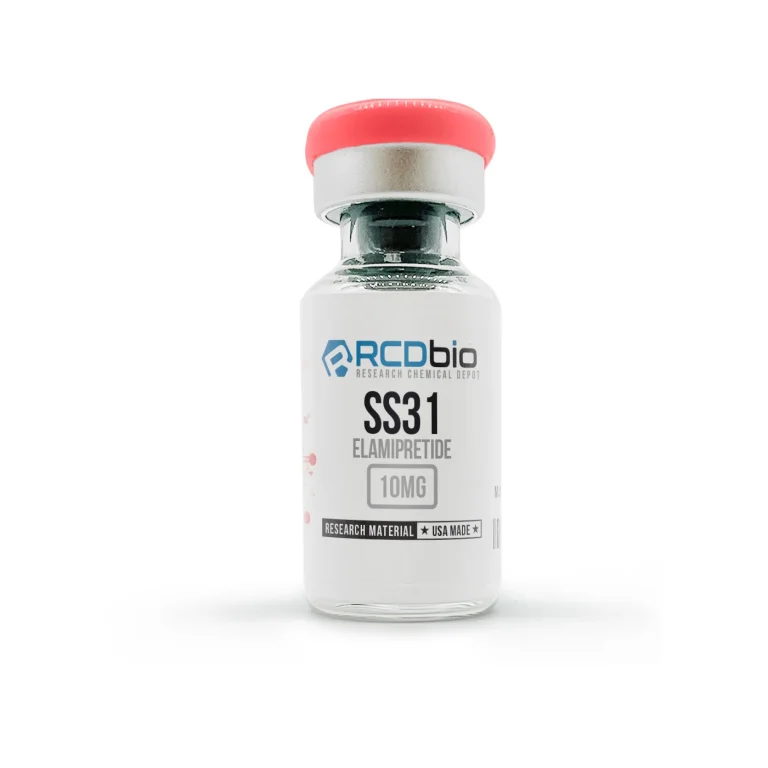

Description
What is SS-31 (Elamipretide)?
SS-31 (Elamipretide), also known as MTP-131 and previously as Bendavia, is a synthetic aromatic-cationic tetrapeptide with the sequence D-Arg-2′,6′-dimethyltyrosine-Lys-Phe-NH2 (D-Arg-Dmt-Lys-Phe-NH2). It belongs to the Szeto-Schiller (SS) family of mitochondria-targeted peptides developed by Hazel H. Szeto and Peter W. Schiller. The compound is characterised by an alternating pattern of cationic and aromatic residues: D-Arg (cationic), Dmt (aromatic), Lys (cationic), and Phe (aromatic). This architectural motif confers cell membrane permeability in an energy-independent, non-saturable manner and drives 1000- to 5000-fold accumulation at the inner mitochondrial membrane, where it binds with high affinity to cardiolipin — an anionic phospholipid essential for cristae structure and electron transport chain function. The 2′,6′-dimethyltyrosine (Dmt) residue at position 2 is a modified non-coded aromatic amino acid; the D-arginine at position 1 confers resistance to aminopeptidase degradation relative to L-arginine.
Elamipretide has been investigated across a broad range of preclinical disease models — including heart failure, ischaemia-reperfusion injury, Barth syndrome, primary mitochondrial myopathy, neurodegeneration, and ageing-related mitochondrial dysfunction — with the cardiolipin-binding and cytochrome c peroxidase inhibition mechanism characterised as the primary basis for its mitochondrial bioenergetic restoration activity.
Elamipretide (FORZINITY, elamipretide HCl injection) received FDA accelerated approval on September 19, 2025, becoming the first approved treatment for Barth syndrome and the first FDA-approved mitochondria-targeted therapeutic. The approved pharmaceutical formulation is administered by subcutaneous injection at defined doses for patients with Barth syndrome weighing at least 30 kg. Research-grade SS-31 supplied by RCDbio is not FORZINITY, is not the pharmaceutical formulation, and is not approved or intended for any human therapeutic use. It is not a dietary supplement and is not intended for human consumption or self-administration. All RCDbio research compounds are supplied strictly for laboratory and research purposes only.
Chemical Properties
| Property | Detail |
| Product Type | Synthetic Aromatic-Cationic Tetrapeptide / Mitochondria-Targeted Peptide (Szeto-Schiller SS Peptide) |
| Product Name | SS-31 (Elamipretide) |
| Application | Scientific / Research Use Only |
| CAS Number | 736992-21-5 (free base); 72244098-12-0 (HCl salt) |
| Molar Mass | 639.802 g/mol (free base) |
| Chemical Formula | C32H49N9O5 (free base) |
| PubChem CID | 11764719 |
| IUPAC Name | (2S)-6-Amino-2-[[(2S)-2-[[(2R)-2-amino-5-(diaminomethylideneamino)pentanoyl]amino]-3-(4-hydroxy-2,6-dimethylphenyl)propanoyl]amino]-N-[(2S)-1-amino-1-oxo-3-phenylpropan-2-yl]hexanamide |
| Peptide Sequence | D-Arg-2′,6′-dimethyltyrosine(Dmt)-Lys-Phe-NH2; C-terminal amide; D-arginine at position 1 |
| Non-Coded Residues | 2′,6′-dimethyltyrosine (Dmt) at position 2 (non-coded aromatic amino acid); D-Arg at position 1 (D-amino acid for aminopeptidase resistance) |
| Synonyms | Elamipretide; MTP-131; Bendavia; FORZINITY (pharmaceutical brand); H-D-Arg-Dmt-Lys-Phe-NH2 |
| FDA Approval Status | Accelerated approval granted September 19, 2025 as FORZINITY (elamipretide HCl injection) for Barth syndrome. Research-grade SS-31 is NOT the pharmaceutical product and is not approved or intended for human use. |
| Physical Form | Lyophilized white to off-white powder |
| Solubility | Freely soluble in water and PBS; compatible with standard aqueous buffers; cell-permeable in biological systems |
| Storage (Lyophilized) | −20°C long-term; 2–8°C short-term; sealed; protected from light |
| Storage (Reconstituted) | 4°C; use within 48–72 hours; avoid repeated freeze-thaw cycles |
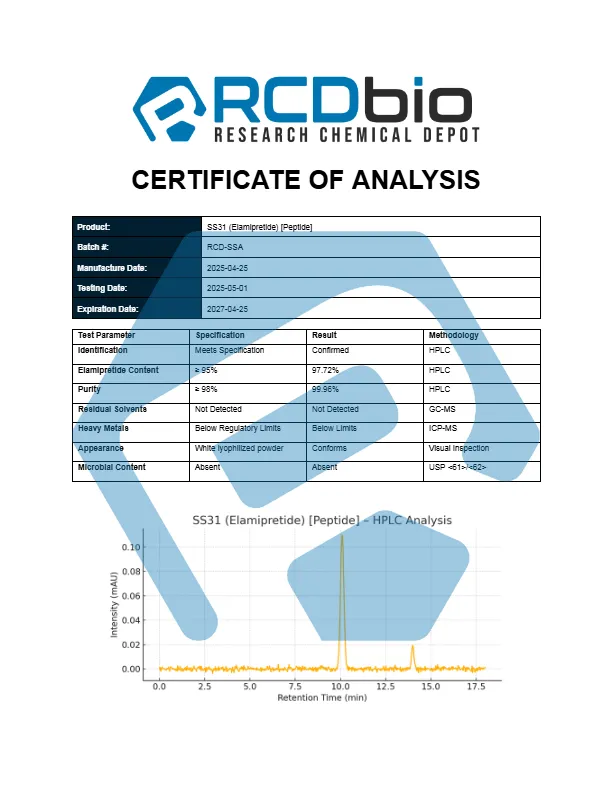
| Purity | ≥98% (HPLC verified, independent third-party laboratory analysis) |
| WADA Status | Elamipretide is not explicitly named on the 2026 WADA Prohibited List. As a mitochondria-targeted peptide with pharmacological activity, S0 (Non-Approved Substances) provisions may apply for research-grade material in sport-adjacent research contexts. The pharmaceutical FORZINITY formulation may qualify for a Therapeutic Use Exemption (TUE) under specific conditions; research-grade material is not eligible. Verify at GlobalDRO.com before use. |
How Does SS-31 Work?
SS-31’s mechanism is centred on its high-affinity binding to cardiolipin at the inner mitochondrial membrane, which prevents cytochrome c peroxidase activity, preserves electron transport chain function, and restores mitochondrial bioenergetics under conditions of oxidative stress or ischaemia.
Mitochondrial Membrane Targeting and Accumulation
SS-31’s alternating cationic-aromatic sequence architecture drives cell membrane penetration in an energy-independent, non-saturable manner — attributed to both electrostatic interactions (cationic D-Arg and Lys residues interacting with anionic membrane phospholipids) and aromatic-lipid interactions (Dmt and Phe residues inserting into the hydrophobic membrane core). Once inside the cell, SS-31 accumulates 1000- to 5000-fold at the inner mitochondrial membrane, where cardiolipin — an anionic phospholipid unique to mitochondria — is highly concentrated. The electrostatic attraction between SS-31’s positive charge (+3 net) and cardiolipin’s negative charge drives preferential inner membrane association without requiring membrane potential, enabling accumulation even in depolarised or dysfunctional mitochondria [Birk et al., 2013].
Cardiolipin Binding and Cytochrome c Peroxidase Inhibition
SS-31 binds cardiolipin with high affinity, as demonstrated by polarity-sensitive fluorescent analogue studies in model and mitochondrial membranes. By forming a high-affinity complex with cardiolipin, SS-31 inhibits the conversion of cytochrome c into a cardiolipin-dependent peroxidase — a pathological reaction that occurs when cytochrome c dissociates from the inner membrane under oxidative or ischaemic conditions and catalyses cardiolipin peroxidation [Birk et al., 2013]. Preventing cardiolipin peroxidation preserves the integrity of inner membrane cristae architecture, maintains cytochrome c in its electron-carrying (rather than peroxidase) functional state, and sustains Complex I, Complex III, and Complex IV activity in the electron transport chain [Szeto, 2014].
Electron Transport Chain Stabilisation and ATP Synthesis Restoration
By preserving cardiolipin integrity and cristae architecture, SS-31 supports the supramolecular organisation of electron transport chain complexes into functionally coupled supercomplexes (respirasomes). In preclinical ischaemia-reperfusion models, SS-31 significantly accelerated ATP recovery after ischaemia and reduced acute kidney injury — findings attributed to re-energisation of ischaemic mitochondria through restoration of cardiolipin-dependent Complex I-III electron transfer [Birk et al., 2013]. ATP production restoration has been characterised in isolated mitochondria, cell culture systems, and multiple animal disease model preparations.
ROS Scavenging via 2′,6′-Dimethyltyrosine
The Dmt residue at position 2 confers intrinsic free radical scavenging activity through the modified phenol ring’s enhanced electron-donating capacity relative to unmodified tyrosine. This contributes to ROS attenuation in mitochondria-proximal cell compartments. However, SS-31 research has increasingly attributed the primary mechanism of action to cardiolipin binding and membrane electrostatic modulation rather than direct antioxidant scavenging, as the membrane-level mechanism explains observations across diverse disease models more comprehensively than antioxidant activity alone.
Key Research Findings
In preclinical, in vitro, and clinical research contexts, SS-31 has been associated with the following observations:
- Cardiolipin binding and cytochrome c peroxidase inhibition: High-affinity cardiolipin binding demonstrated using fluorescent SS-31 analogues in isolated mitochondrial membrane preparations; cytochrome c peroxidase activity inhibited by SS-31/cardiolipin complex [Birk et al., 2013].
- Ischaemia-reperfusion ATP recovery: SS-31 administration accelerated ATP recovery and reduced acute kidney injury in preclinical renal ischaemia-reperfusion models; the mechanism was attributed to cardiolipin-dependent Complex I-III electron transfer restoration [Birk et al., 2013].
- Barth syndrome clinical trial: Phase 2/3 randomised controlled trial demonstrated significant improvement in knee extensor muscle strength in Barth syndrome patients — the primary endpoint supporting FDA accelerated approval of FORZINITY on September 19, 2025.
- Heart failure models: In preclinical heart failure models, SS-31 improved mitochondrial cristae morphology, increased ATP production, and reduced oxidative stress markers in cardiomyocyte preparations.
- Inner mitochondrial membrane electrostatics: Biophysical studies confirmed that SS-31 modifies mitochondrial membrane surface electrostatics and promotes cristae curvature stabilisation in both model membrane and native mitochondrial preparations.
All preclinical findings above are derived from in vitro and in vivo animal model data. The Barth syndrome clinical finding relates to the pharmaceutical FORZINITY formulation. Research-grade SS-31 from RCDbio is not FORZINITY and is not approved or intended for human use. These observations do not constitute evidence of efficacy or safety for research-grade material in any human condition.
What are the Potential Research Applications of SS-31?
In controlled laboratory environments, SS-31 has been investigated for the following research applications. These are observed in preclinical and in vitro contexts and do not constitute claims of efficacy or safety for research-grade material outside approved protocols.
Cardiolipin Biology and Inner Mitochondrial Membrane Research SS-31 is employed as the primary reference compound for studying cardiolipin-protein interactions at the inner mitochondrial membrane. Research employs polarity-sensitive fluorescent SS-31 analogues, lipid bilayer biophysics, and cryo-EM structural approaches to characterise how cardiolipin binding affects membrane electrostatics, cristae curvature, and supercomplex organisation.
Mitochondrial Bioenergetics and Electron Transport Chain Research In isolated mitochondria, permeabilised cell preparations, and intact cell systems, SS-31 is investigated for its effects on respiratory complex activity, mitochondrial membrane potential, ATP synthesis rates, and the organisation of electron transport chain supercomplexes. Research examines the relationship between cardiolipin integrity and ETC functional coupling.
Ischaemia-Reperfusion Injury Models SS-31 is a standard tool in preclinical ischaemia-reperfusion injury research across cardiac, renal, hepatic, and neurological model systems. Studies examine cardiolipin oxidation as a therapeutic target, ATP recovery kinetics, mitochondrial cristae morphology, and cytochrome c release in tissue-specific ischaemia preparations.
Barth Syndrome and Primary Mitochondrial Disease Research In TAZ-deficient cell lines and mouse models of Barth syndrome, SS-31 is investigated for its effects on abnormal cardiolipin remodelling, mitochondrial morphology, and bioenergetic function. Research examines the relationship between cardiolipin composition and SS-31 binding affinity in disease-relevant cell systems.
Ageing-Related Mitochondrial Dysfunction Research. In aged rodent tissue preparations, SS-31 is investigated for its capacity to restore age-associated declines in mitochondrial cristae integrity, respiratory capacity, and ATP production. Research examines mitochondrial dysfunction as a mechanism of age-related tissue decline and SS-31’s effects on these markers in aged muscle, cardiac, and neuronal preparations.
What are the Potential Side Effects of SS-31?
The following observations are derived from preclinical studies and clinical trial data for the pharmaceutical formulation. Research-grade SS-31 adverse effects have not been independently characterised.
- Generally well-tolerated profile reported in preclinical safety studies and clinical trials of the pharmaceutical elamipretide formulation; favourable safety profile characterised across multiple Phase 2 trials
- Injection site reactions (erythema, bruising) were reported at the subcutaneous injection site in clinical trial participants receiving the pharmaceutical formulation — route-specific finding not applicable to in vitro research use
- Hypersensitivity reactions were reported at low frequency in clinical trial populations; contraindicated in patients with known serious hypersensitivity to elamipretide in the approved pharmaceutical context
- No significant systemic toxicity findings reported in preclinical rodent and non-human primate safety studies at research-relevant doses
- No human safety or tolerability data have been established for research-grade SS-31 outside approved clinical trial contexts. Observations above are from the pharmaceutical formulation and should not be extrapolated to research-grade material.
Risk & Handling
Handling Precautions
SS-31 should only be handled by trained laboratory personnel. Appropriate PPE is required: nitrile gloves, a laboratory coat, and eye protection at a minimum. When working with lyophilized powder, use within a laminar flow cabinet or a clean area. Avoid aerosol generation during reconstitution. The D-Arg residue at position 1 confers aminopeptidase resistance; standard peptide handling precautions apply.
Exposure Risks
Risk Tier: LOW
SS-31 has demonstrated a favourable acute safety profile in published preclinical studies and clinical trial populations at research-relevant doses. The compound’s primary pharmacological target — the inner mitochondrial membrane — is intracellular; systemic exposure at research concentrations is not expected to produce significant adverse effects based on available preclinical data. No human safety or tolerability data has been established for research-grade SS-31.
Storage
- Lyophilized form: Store at −20°C long-term; 2–8°C acceptable for short-term use; sealed, light-protected container
- Reconstituted form: Store at 4°C; use within 48–72 hours of reconstitution
- Do not subject to repeated freeze-thaw cycles; D-amino acid and Dmt residue integrity may be affected
- Protect from prolonged light exposure
Frequently Asked Questions
Q: What is SS-31, and what is it investigated for in research? A: SS-31 (Elamipretide, D-Arg-Dmt-Lys-Phe-NH2) is a synthetic aromatic-cationic tetrapeptide that accumulates at the inner mitochondrial membrane via cardiolipin binding. It is investigated in preclinical and clinical research contexts for cardiolipin-dependent cytochrome c peroxidase inhibition, electron transport chain stabilisation, ATP synthesis restoration, and mitochondrial bioenergetics research across cardiac, renal, muscular, and neurological disease models. The pharmaceutical formulation (FORZINITY) received FDA accelerated approval for Barth syndrome in September 2025. Research-grade SS-31 from RCDbio is not a pharmaceutical product and is not intended for human use.
Q: Is SS-31 FDA approved? A: The pharmaceutical formulation — FORZINITY (elamipretide HCl injection) by Stealth BioTherapeutics — received FDA accelerated approval on September 19, 2025, as the first treatment for Barth syndrome and the first FDA-approved mitochondria-targeted therapeutic. Research-grade SS-31 from RCDbio is not FORZINITY, is not the approved pharmaceutical formulation, and is not approved or intended for any human therapeutic use.
Q: How does SS-31 accumulate preferentially at mitochondria? A: SS-31 crosses cell membranes in an energy-independent, non-saturable manner driven by its alternating cationic-aromatic sequence architecture. Once inside the cell, its net +3 positive charge drives electrostatic attraction to cardiolipin, the anionic phospholipid uniquely concentrated at the inner mitochondrial membrane. This results in 1000- to 5000-fold accumulation at the inner membrane. Crucially, this accumulation does not depend on mitochondrial membrane potential, enabling targeting even in depolarised or dysfunctional mitochondria that are characteristic of ischaemic or disease states.
Q: What is the significance of cardiolipin binding for SS-31’s mechanism? A: Cardiolipin is essential for inner mitochondrial membrane cristae structure and electron transport chain supercomplex organisation. When cardiolipin is peroxidised — as occurs under oxidative stress and ischaemia — cristae architecture collapses, cytochrome c dissociates and becomes a peroxidase, and ATP synthesis fails. SS-31 binding to cardiolipin prevents this peroxidative cycle: it inhibits cytochrome c peroxidase activity, preserves cristae architecture, and sustains electron transport chain coupling. This mechanism explains SS-31’s efficacy across diverse mitochondrial disease models [Birk et al., 2013].
Q: How should research-grade SS-31 be stored? A: Lyophilized SS-31 should be stored at −20°C long-term or 2–8°C for short-term use, in a sealed, light-protected container. Once reconstituted, store at 4°C and use within 48–72 hours. Repeated freeze-thaw cycles should be avoided. The D-Arg residue at position 1 and the Dmt aromatic modification confer enhanced metabolic stability relative to unmodified peptides.
Q: What distinguishes SS-31 from other Szeto-Schiller peptides? A: SS-31 (D-Arg-Dmt-Lys-Phe-NH2) is the lead compound of the SS peptide family, which includes SS-02 (D-Arg-Tyr-Lys-Phe-NH2) and SS-20 (Phe-D-Arg-Phe-Lys-NH2). SS-31 uniquely combines D-Arg (for aminopeptidase resistance), 2′,6′-dimethyltyrosine (Dmt, for enhanced ROS scavenging and aromatic-cardiolipin interaction), lysine (cationic), and phenylalanine (aromatic). The Dmt residue’s ortho-methyl substitutions increase electron donation relative to unmodified Tyr, conferring stronger peroxidase-inhibiting activity on the cardiolipin-bound state. SS-31 is the first SS peptide to enter clinical development and achieve regulatory approval.
Related Research Compounds
Researchers investigating SS-31 may also be interested in the following compounds currently available for laboratory research at RCDbio:
- Humanin — A mitochondria-derived 24-amino acid peptide (MDP) investigated in preclinical models for anti-apoptotic Bax inhibition and CNTFR/gp130/STAT3 pathway activation; shares the mitochondria-biology and neuroprotection research context with SS-31.
- Epithalon — A synthetic tetrapeptide investigated in preclinical models for telomerase activity, mitochondrial DNA protection, and cellular ageing; relevant to comparative mitochondria-targeted peptide and longevity research alongside SS-31.
All products listed are for laboratory and research purposes only.
References
- Birk, A. V., Liu, S., Soong, Y., Mills, W., Singh, P., Warren, J. D., Seshan, S. V., Pardee, J. D., & Szeto, H. H. (2013). The mitochondrial-targeted compound SS-31 re-energizes ischemic mitochondria by interacting with cardiolipin. Journal of the American Society of Nephrology, 24(8), 1250–1261. https://pubmed.ncbi.nlm.nih.gov/23813215/
- Szeto, H. H. (2014). First-in-class cardiolipin-protective compound as a therapeutic agent to restore mitochondrial bioenergetics. British Journal of Pharmacology, 171(8), 2029–2050. https://pubmed.ncbi.nlm.nih.gov/24215475/
- Mitchell, W., Ng, E. A., Tamucci, J. D., Boyd, K. J., Sathappa, M., Coscia, A., Pan, M., Han, X., Eddy, N. A., May, E. R., Szeto, H. H., & Alder, N. N. (2020). The mitochondria-targeted peptide SS-31 binds lipid bilayers and modulates surface electrostatics as a key component of its mechanism of action. Journal of Biological Chemistry, 295(21), 7452–7469. https://pubmed.ncbi.nlm.nih.gov/32291280/
- Reid Thompson, W., Hornby, B., Manuel, R., Brady, J., Flanigan, K., Leshner, R. T., & Allen, H. D. (2021). A phase 2/3 randomized clinical trial followed by an open-label extension to evaluate the effectiveness of elamipretide in Barth syndrome, a genetic disorder of mitochondrial cardiolipin metabolism. Genetics in Medicine, 23(3), 471–478. https://pubmed.ncbi.nlm.nih.gov/33177697/
Disclaimer
SS-31 (Elamipretide) is exclusively for laboratory research purposes. RCDbio products are not intended to diagnose, prevent, treat, or cure any disease or medical condition. Research-grade SS-31 is not the pharmaceutical product FORZINITY (elamipretide HCl injection) and is not approved or intended for any human therapeutic use.
The Food and Drug Administration has approved elamipretide as FORZINITY for Barth syndrome. Research-grade SS-31 from RCDbio is not this approved product. Researchers must comply with all applicable local, state, and federal laws and regulations governing the purchase and use of research compounds. By purchasing, you agree to our Terms and Conditions. RCDbio reserves the right to refuse sales to unauthorized individuals.
ATTENTION: All RCDbio products are strictly for LABORATORY AND RESEARCH PURPOSES ONLY. They are not intended for human consumption, veterinary use, or any other non-research application. For queries, complaints, or support, contact support@rcdbio.co
Reviews
There are no reviews yet