

Description
What is Orexin A?
Orexin A (also designated hypocretin-1) is a 33-amino-acid excitatory neuropeptide belonging to the orexin/hypocretin peptide family. It is derived by proteolytic cleavage of the 130-amino-acid precursor protein prepro-orexin, encoded by the HCRT gene on chromosome 17q21. Structurally, Orexin A is distinguished by an N-terminal pyroglutamyl (pyroGlu) residue and two intramolecular disulfide bridges linking cysteine residues at positions 6–12 and 7–14, which confer conformational rigidity and contribute to receptor selectivity relative to the shorter, unstructured Orexin B isoform.
In laboratory settings, synthetic Orexin A serves as the primary endogenous reference ligand for the orexin receptor system. It exhibits high-affinity, non-selective agonism at both orexin receptor type 1 (OX1R) and orexin receptor type 2 (OX2R), each a class A (rhodopsin-type) G protein-coupled receptor (GPCR). OX1R demonstrates markedly higher binding selectivity for Orexin A relative to Orexin B, whereas OX2R binds both isoforms with comparable affinity. This differential receptor engagement makes synthetic Orexin A a critical pharmacological tool for dissecting receptor subtype-specific signaling in cell-based and in vivo preclinical systems.
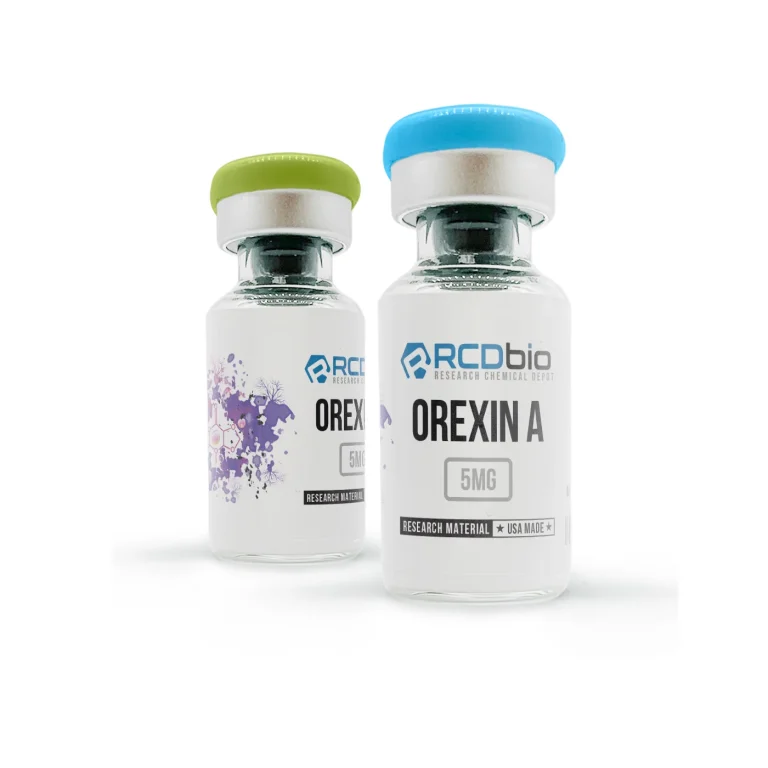
Orexin A supplied by RCDbio is intended strictly for laboratory and research purposes. It is not approved by the Food and Drug Administration for use in this research-grade, non-pharmaceutical form. It is not a dietary supplement and is not intended for human consumption or therapeutic self-administration.
Chemical Properties
| Property | Detail |
| Product Type | Synthetic Cyclic Neuropeptide (Disulfide-Bridged 33-mer) |
| Product Name | Orexin A (Hypocretin-1) |
| Application | Scientific / Research Use Only |
| CAS Number | 205640-90-0 (free base) · 205599-75-3 (alternative registry) |
| Molar Mass | 3,561.09 g/mol (free base, C₁₅₂H₂₄₃N₄₇O₄₄S₄) |
| Chemical Formula | C₁₅₂H₂₄₃N₄₇O₄₄S₄ |
| Sequence | pyroGlu-Pro-Leu-Pro-Asp-Cys-Cys-Arg-Gln-Lys-Thr-Cys-Ser-Cys-Arg-Leu-Tyr-Glu-Leu-Leu-His-Gly-Ala-Gly-Asn-His-Ala-Ala-Gly-Ile-Leu-Thr-Leu-NH₂ (Disulfide bridges: Cys6–Cys12; Cys7–Cys14) |
| IUPAC Name | See PubChem CID 56842143 for full systematic IUPAC string (peptide backbone exceeds standard inline notation) |
| Synonyms | Hypocretin-1 (HCRT1); prepro-orexin[33–66] (endogenous fragment designation) |
| Physical Form | Lyophilized white to off-white powder |
| Solubility | Soluble in aqueous buffers (0.1% BSA/PBS recommended); avoid strongly reducing reconstitution conditions — DTT, β-mercaptoethanol, or TCEP will disrupt the two intramolecular disulfide bridges and inactivate the peptide |
| Storage (Lyophilized) | −20°C or below; sealed, light-protected container with desiccant; protect from humidity |
| Storage (Reconstituted) | 4°C; use within 24–48 hours; do not subject to repeated freeze-thaw cycles; discard if turbid or particulate matter is observed |
| PubChem CID | 56842143 |
| Purity | ≥98% (HPLC verified, independent third-party laboratory analysis; COA available per batch) |
| WADA Status | Orexin A is not listed by name on the current WADA Prohibited List; however, as a peptide hormone ligand with CNS activity, it may fall within the S2 (Peptide Hormones, Growth Factors, Related Substances, and Mimetics) category depending on application context. Researchers engaged in sport-adjacent studies should verify the current status at GlobalDRO.com before use. |
How Does Orexin A Work?
Orexin A exerts its pharmacological activity through high-affinity binding to OX1R and OX2R two class A GPCRs expressed widely across arousal-related, limbic, and hypothalamic neuronal populations. Both receptor subtypes are primarily coupled to Gq/11 proteins, with additional coupling to Gi/o and Gs subpopulations in a cell-type-dependent manner. The downstream signaling cascades initiated by Orexin A binding have been characterized across multiple preclinical cell preparations and in vivo rodent models.
OX1R/OX2R–Gq/11–PLC/IP3/Calcium Signaling In neuronal cell preparations and HEK293 cell lines stably expressing OX1R, Orexin A binding activates the Gq/11 subunit, leading to phospholipase C (PLC) stimulation and subsequent hydrolysis of phosphatidylinositol 4,5-bisphosphate (PIP2) into inositol 1,4,5-trisphosphate (IP3) and diacylglycerol (DAG). IP3-mediated calcium release from intracellular endoplasmic reticulum stores produces a transient cytosolic Ca²⁺ elevation, confirmed by fluorometric assays in OX1R-expressing cell systems. DAG simultaneously activates protein kinase C (PKC), including the PKCδ isoform; ERK1/2 phosphorylation has also been characterized as a downstream consequence of OX1R activation in HEK293Ox1R preparations. Protein kinase D1 (PKD1) activation has been observed as a parallel early-signaling event whose kinetics mirror the Ca²⁺ elevation response in a dose-dependent manner.
Non-Selective Cation Channel Activation and Membrane Depolarization Beyond the PLC/IP3 axis, OX1R activation by Orexin A has been demonstrated to depolarize neurons through modulation of non-selective cation channels (NSCCs) and inhibition of G protein-regulated inward rectifier (GIRK/Kir) channels in rodent electrophysiology preparations. Sodium/calcium exchanger activation has also been identified as a mechanism contributing to sustained post-receptor depolarization. These ion channel effects operate in parallel with, and often independently of, the PLC-mediated pathway, with cell-type specificity determining the predominant depolarization mechanism. In rat retinal ganglion cell (GC) preparations, Orexin A was observed to potentiate L-type calcium currents (IBa,L) via the Gq/PI-PLC/IP3/Ca²⁺/PKC pathway, an effect blocked by the selective OX1R antagonist SB334867.
Arousal Circuit Projections and Monoaminergic Modulation Orexin A-producing neurons originate in the lateral and posterior hypothalamus and project to multiple arousal-regulatory nuclei, including the locus coeruleus (noradrenergic), tuberomammillary nucleus (histaminergic), ventral tegmental area (dopaminergic), and dorsal raphe (serotonergic). In rodent in vivo optogenetic and electrophysiology studies, intracerebroventricular administration of Orexin A was observed to activate both OX1R-positive noradrenergic neurons at the locus coeruleus and OX2R-expressing histaminergic neurons at the tuberomammillary nucleus. This dual receptor engagement differentiates Orexin A from OX2R-selective agonist tools, enabling mechanistic dissection of receptor-subtype-specific contributions to arousal circuit regulation.
Hypothalamic Energy and Feeding Circuit Interactions In rodent preclinical models, central administration of Orexin A dose-dependently modulated feeding behavior and energy expenditure parameters measured in metabolic cages. Orexin neurons have been demonstrated to integrate metabolic input from glucose-sensitive neurons, leptin signaling, and ghrelin via electrophysiological coupling characterized in rodent hypothalamic slice preparations. These observations position Orexin A as a tool compound for investigating the intersection of arousal circuit activity and energy balance signaling in preclinical in vitro and in vivo systems.
Key Research Findings
- OX1R/OX2R Gq-coupling: Gq/11-mediated PLC/IP3/Ca²⁺ elevation characterized in neuronal cell preparations and OX1R-stably transfected HEK293 cell systems; PKCδ and ERK1/2 co-activation identified as downstream mechanistic components. [Kukkonen et al.; Scammell & Winrow, 2011]
- Arousal circuit receptor engagement: Intracerebroventricular Orexin A activated both OX1R-positive locus coeruleus noradrenergic and OX2R-expressing tuberomammillary histaminergic neurons in orexin-knockout murine models in vivo; OX2R-selective agonism alone was sufficient to rescue the sleep/wake fragmentation phenotype. [Yamamoto et al., 2022]
- Narcolepsy model: Genetic loss of orexin-producing hypothalamic neurons is sufficient to induce narcolepsy-cataplexy in murine and canine in vivo models; orexin receptor antagonism recapitulates non-REM and REM sleep without inducing overt cataplexy in acute administration studies. [Scammell & Winrow, 2011; PMID 33609365]
- Energy balance and feeding signaling: Central administration of Orexin A dose-dependently increased food intake, locomotor activity, and metabolic rate in rodent in vivo models; orexin neurons were characterized as integrators of metabolic cues, including leptin, ghrelin, and glucose, in rodent hypothalamic electrophysiology preparations. [Cai et al., 2010]
- Retinal ganglion cell L-type calcium current potentiation: OX1R activation by Orexin A potentiated L-type-like barium currents (IBa,L) in isolated rat retinal ganglion cell preparations via the Gq/PLC/IP3/PKC pathway; effect fully blocked by SB334867 and abolished by intracellular GDP-β-S. [PMID 26259903]
All findings listed above are derived from preclinical or in vitro data. No conclusions regarding human therapeutic efficacy can be drawn from these observations. These findings do not constitute evidence of safety or efficacy in any human condition or organism.
What are the Potential Research Applications of Orexin A?
OX1R and OX2R GPCR Pharmacology Synthetic Orexin A is employed as the primary endogenous reference agonist in studies characterizing OX1R and OX2R binding kinetics, receptor activation dynamics, and G protein coupling selectivity. It is used in radioligand competition assays, Ca²⁺ mobilization assays (FLIPR and fluorometric platforms), BRET/FRET-based signaling experiments, and pathway-specific reporter cell systems to investigate Gq vs. Gi/o bias at each receptor subtype. Its nonselective agonist profile makes it the benchmark compound against which subtype-selective agonists and antagonists including suvorexant, SB-334867, and experimental OX2R-selective compounds — are characterized in comparative in vitro pharmacology studies.
Sleep-Wake Cycle and Narcolepsy Preclinical Research Orexin A is investigated in rodent and canine in vivo models of sleep architecture, including electroencephalography (EEG) and electromyography (EMG)-coupled recording paradigms used to characterize sleep stage transitions. In orexin-knockout murine models, intracerebroventricular Orexin A administration has been used to rescue sleep/wake fragmentation and cataplexy-like episodes, providing a positive-control benchmark for evaluating candidate orexin receptor agonist therapies in preclinical narcolepsy model systems.
Energy Homeostasis and Hypothalamic Circuit Studies In rodent hypothalamic slice preparations and in vivo metabolic cage paradigms, Orexin A is investigated for its role in modulating hypothalamic feeding circuits, including interactions with leptin-sensitive neurons, ghrelin-responsive orexin neurons, and glucose-sensing pathways. It serves as a research tool for studying the cellular integration of arousal and metabolic state in lateral hypothalamic area (LHA) neuronal populations.
Alzheimer’s Disease and Neurodegeneration Models The orexin system has been investigated in cell-based and rodent in vivo neuroinflammation and neurodegeneration models. Orexin A has been evaluated as a reference compound in studies examining orexinergic signaling deficits in Alzheimer’s disease-related preclinical systems, where disruption of orexin neuron populations has been observed in amyloid-transgenic murine models.
Cardiovascular and Autonomic Research In rodent in vivo preparations, central administration of Orexin A has been observed to modulate cardiovascular parameters, including heart rate and blood pressure, through central sympathoexcitatory pathways. It is used as a tool compound in studies of orexinergic contributions to autonomic cardiovascular regulation.
These applications are observed in preclinical and in vitro contexts only and do not constitute claims of efficacy or safety in any organism.
What are the Potential Side Effects of Orexin A?
- Cardiovascular excitation including elevated heart rate and blood pressure observed in rodent in vivo models following central (intracerebroventricular) administration at pharmacologically active doses; attributed to orexinergic activation of central sympathoexcitatory projections.
- Hyperarousal and extended wake state observed in rodent in vivo EEG/EMG paradigms following systemic or central Orexin A administration; dose-dependent and reversible in acute administration studies.
- Hyperphagic feeding behavior observed in rodent in vivo models following intracerebroventricular administration is attributed to OX1R-mediated activation of hypothalamic feeding circuits; magnitude is dependent on dose and delivery route.
- Drug-seeking and reinforcement behavior observed in wild-type murine models following intracerebroventricular Orexin A administration was not replicated with OX2R-selective agonists in the same model system, suggesting OX1R-mediated reinforcing properties as a potential confound in reward circuit research designs.
- Autonomic thermoregulatory responses observed in rodent in vivo preparations; dose-dependent; not uniform across species or delivery routes.
No human safety or tolerability data pertaining to research-grade Orexin A has been established. These observations are derived from experimental systems and should not be extrapolated to human or animal outcomes.
Risk & Handling
Risk Tier: MODERATE
Handling Precautions Orexin A should be handled exclusively by trained laboratory personnel with appropriate institutional safety training. Minimum personal protective equipment: nitrile gloves, laboratory coat, and eye protection. Given its lyophilized powder form, reconstitution should be performed in a biosafety cabinet or appropriate containment environment to minimize aerosol generation. Reducing agents (DTT, β-mercaptoethanol, TCEP) must not be used during preparation or storage, as these will disrupt the two intramolecular disulfide bridges and render the peptide inactive. All reconstitution solvents and instruments must be free of reducing agents. Any reconstituted solution that appears turbid, discolored, or contains visible particulate matter should be discarded immediately.
Exposure Risks Orexin A is a pharmacologically active endogenous neuropeptide with well-characterized excitatory activity at OX1R and OX2R in preclinical systems. At research-relevant concentrations in cell-based assays, it is not acutely cytotoxic; however, in rodent in vivo studies, central administration at active doses has been associated with cardiovascular excitation, hyperarousal, and reinforcement behavior at OX1R, indicating meaningful CNS and autonomic pharmacological activity. The plasma half-life of Orexin A in intravenous rodent models is short (estimated minutes range), reflecting peptidase-mediated degradation; however, central effects following intracerebroventricular administration exhibit extended duration relative to peripheral exposure. No human safety data has been established for research-grade Orexin A. Researchers should exercise handling caution appropriate to a potent, biologically active, disulfide-bridged neuropeptide with CNS excitatory activity.
Storage
- Lyophilized form: Store at −20°C or below; sealed, light-protected container with desiccant
- Reconstituted form: Store at 4°C; use within 24–48 hours of reconstitution
- Do not subject to repeated freeze-thaw cycles; disulfide bridges are susceptible to progressive oxidative degradation with each thermal cycle
- Do not store or prepare in the presence of reducing agents; DTT, β-mercaptoethanol, or TCEP will disrupt the disulfide bonds and inactivate the compound
- Discard any reconstituted solution that appears turbid, discolored, or shows particulate matter
FAQs
Q: What is Orexin A and what is it investigated for in research? A: Orexin A (hypocretin-1) is a synthetic 33-amino-acid neuropeptide and endogenous agonist at orexin receptor types 1 and 2 (OX1R and OX2R), both class A G protein-coupled receptors. In laboratory settings, it is investigated as a reference ligand for GPCR pharmacology studies, a tool compound in sleep-wake cycle and narcolepsy model research, and a mechanistic probe for hypothalamic energy balance and arousal circuit signaling. All research applications are conducted in preclinical in vitro and in vivo systems. Synthetic Orexin A supplied by RCDbio is not approved by the FDA for human use and is not intended for human consumption or therapeutic application.
Q: What is the half-life of Orexin A in preclinical models? A: Orexin A undergoes rapid peptidase-mediated degradation in peripheral circulation. In rodent intravenous models, plasma half-life is estimated in the low-minutes range, consistent with endopeptidase activity. Central (intracerebroventricular) administration in murine models produces pharmacological effects of considerably longer duration than intravenous delivery, reflecting differential access to CNS peptidases. In vitro stability in aqueous buffer at 4°C is maintained for 24–48 hours following reconstitution under non-reducing conditions. These figures are derived from laboratory and preclinical model systems and do not represent human pharmacokinetic data for research-grade material.
Q: How should Orexin A be stored to maintain stability? A: Lyophilized Orexin A should be stored at −20°C or below in a sealed, light-protected container with desiccant to prevent moisture uptake. Reconstituted solutions should be stored at 4°C and used within 24–48 hours. Repeated freeze-thaw cycles should be avoided, as the two intramolecular disulfide bridges undergo progressive oxidative degradation with each thermal cycle. Reducing agents including DTT, β-mercaptoethanol, and TCEP must not be present in storage conditions or reconstitution buffers, as these will irreversibly inactivate the peptide.
Q: What reconstitution solvent is typically used for Orexin A in laboratory research? A: In preclinical laboratory practice, Orexin A is commonly reconstituted in sterile aqueous buffer containing 0.1% bovine serum albumin (BSA) in phosphate-buffered saline (PBS) at physiological or near-physiological pH. BSA supplementation reduces adsorptive peptide loss to vessel surfaces and stabilizes the reconstituted solution. Acidic aqueous vehicles (e.g., 0.1% acetic acid) have also been employed in some research protocols. All reconstitution solvents must be free of reducing agents to preserve disulfide bridge integrity.
Q: What toxicity observations have been reported in preclinical studies? A: In rodent in vivo models, central administration of Orexin A at pharmacologically active doses has been associated with cardiovascular excitation (elevated heart rate and blood pressure), hyperarousal, hyperphagic feeding responses, and reinforcement/drug-seeking behavior attributable to OX1R activation. These observations are dose-dependent and have been characterized primarily in acute intracerebroventricular administration paradigms. No chronic toxicity studies specific to research-grade synthetic Orexin A have been published. No human safety or tolerability data has been established for research-grade Orexin A.
Q: What is the difference between OX1R and OX2R binding profiles for Orexin A? A: Orexin A acts as a non-selective, high-affinity agonist at both OX1R and OX2R. OX1R demonstrates significantly higher binding selectivity for Orexin A relative to Orexin B (approximately 100-fold selectivity in radioligand binding assays), while OX2R binds both orexin isoforms with comparable affinity. Both receptor subtypes are primarily coupled to Gq/11 G proteins in neuronal cell preparations, resulting in PLC/IP3/Ca²⁺ cascades, but additional coupling to Gi/o and Gs proteins has been characterized in a cell-type-specific manner. The non-selective profile of Orexin A makes it a useful reference compound for simultaneously engaging both receptor subtypes in experimental designs requiring full orexinergic system activation.
Q: Is Orexin A related to narcolepsy research? A: The orexin system has been mechanistically linked to narcolepsy in multiple preclinical model systems. Genetic loss of orexin-producing neurons in murine, canine, and other models produces narcolepsy-cataplexy phenotypes, and CSF Orexin A measurement is an established biomarker approach for narcolepsy type 1 investigation in clinical neuroscience research. In laboratory settings, synthetic Orexin A is used as a positive-control agonist in receptor pharmacology assays and as a rescue compound in orexin-knockout animal model studies. These are preclinical research applications only and do not represent therapeutic use or clinical administration of research-grade material.
Related Research Compounds
Orexin B (Hypocretin-2) [Peptide] — The 28-amino-acid linear orexin isoform that activates OX2R with similar affinity as OX1R; used in parallel with Orexin A in receptor subtype pharmacology studies and arousal circuit research requiring selective OX2R reference data.
VIP (Vasoactive Intestinal Peptide) [Peptide] — A 28-amino-acid neuropeptide investigated in preclinical models for hypothalamic neuromodulation, circadian pacemaker activity, and autonomic regulatory signaling; employed in comparative studies examining neuropeptide interactions in sleep and arousal circuit research.
DSIP (Delta Sleep Inducing Peptide) [Nasal Spray] — A nonapeptide investigated in preclinical models for sleep-regulatory signaling; used as a comparator compound in sleep architecture and neuromodulation research programs examining non-orexinergic sleep regulatory pathways.
References
- Scammell TE, Winrow CJ. Orexin receptors: pharmacology and therapeutic opportunities. Annu Rev Pharmacol Toxicol. 2011;51:243–266. https://pubmed.ncbi.nlm.nih.gov/21034217/
- Yamamoto H, Nagumo Y, Ishikawa Y, et al. OX2R-selective orexin agonism is sufficient to ameliorate cataplexy and sleep/wake fragmentation without inducing drug-seeking behavior in mouse model of narcolepsy. PLoS One. 2022;17(7):e0271901. https://pubmed.ncbi.nlm.nih.gov/35867683/
- Sakurai T, Amemiya A, Ishii M, et al. Orexins and orexin receptors: a family of hypothalamic neuropeptides and G protein-coupled receptors that regulate feeding behaviour. Cell. 1998;92(4):573–585. https://pubmed.ncbi.nlm.nih.gov/9491897/
- Yin J, Mobarec JC, Kolb P, Bhaskara V. Orexin receptor structure, mechanisms, and pharmacology. Front Pharmacol. 2016. See also: The Orexin/Receptor System: molecular mechanism and therapeutic potential for neurological diseases. https://pubmed.ncbi.nlm.nih.gov/30002617/
- Yao T, et al. Orexin-A potentiates L-type calcium/barium currents in rat retinal ganglion cells. J Neurophysiol. 2015. https://pubmed.ncbi.nlm.nih.gov/26259903/
Disclaimer
Orexin A is exclusively for laboratory research purposes. RCDbio products are not intended to diagnose, prevent, treat, or cure any disease or medical condition.
The Food and Drug Administration has not evaluated the statements on our website. This product is not approved for human or veterinary use. Researchers must comply with all applicable local, state, and federal laws and regulations governing the purchase and use of research compounds. By purchasing, you agree to our Terms and Conditions. RCDbio reserves the right to refuse sales to unauthorized individuals.
ATTENTION: All RCDbio products are strictly for LABORATORY AND RESEARCH PURPOSES ONLY. They are not intended for human consumption, veterinary use, or any other non-research application. For queries, complaints, or support, contact support@rcdbio.co

Reviews
There are no reviews yet