

Description
What is Adamax?
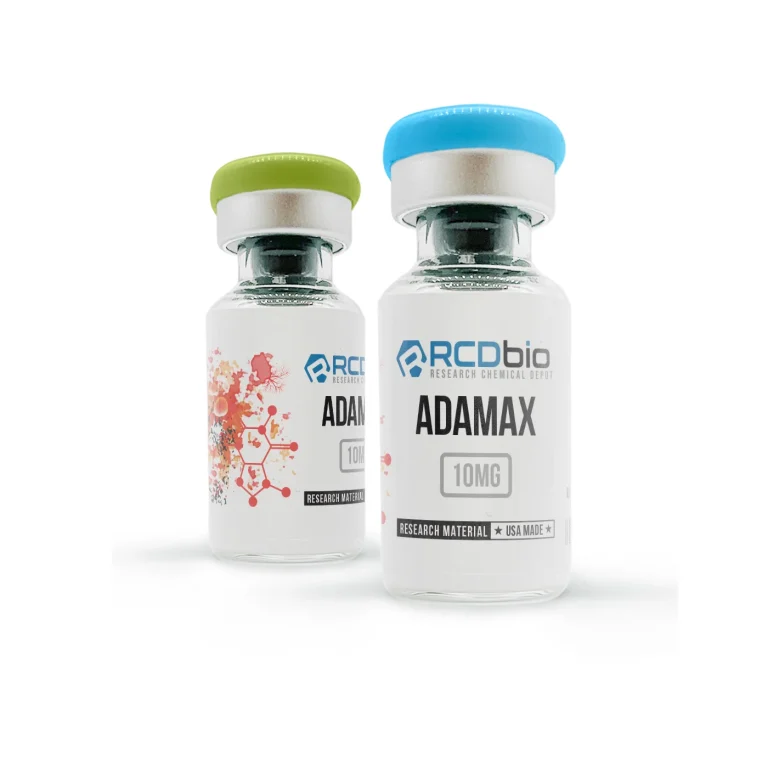
Adamax (Ac-MEHFPGPAG-NH2) is a synthetic nonapeptide designed as a structurally enhanced analogue of Semax, combining elements of two distinct neuropeptide research compounds: the N-acetyl Semax backbone and the adamantyl C-terminal modification from Peptide P021. Its sequence — Ac-Met-Glu-His-Phe-Pro-Gly-Pro-Ala-Gly-NH2 — consists of the Semax heptapeptide (MEHFPGP) with an Ala-Gly dipeptide spacer extension at the C-terminus, terminated with an adamantyl amide group derived from the 1-adamantylamine residue that forms the C-terminal pharmacophore of P021. The N-terminal acetyl group provides aminopeptidase resistance identical to N-Acetyl Semax; the C-terminal adamantyl amide provides both carboxypeptidase resistance through amidation and a hydrophobic, membrane-interacting adamantane cage structure proposed to enhance CNS bioavailability relative to the parent compound.
Adamax was developed and named by Ceretropic, a former Mexico-based research peptide company that synthesised and marketed multiple novel designer neuropeptides outside established pharmaceutical channels. The compound is not of academic or pharmaceutical institutional origin and has no peer-reviewed published research — no published synthesis paper, receptor binding characterisation, pharmacokinetic study, or in vivo biological activity study for Adamax specifically is available in indexed scientific literature as of the date of this writing. Its expected pharmacological activity is inferred entirely from the structural components it incorporates: the Semax core MEHFPGP sequence (whose BDNF/TrkB, melanocortin receptor, and neuroinflammatory gene expression activities are established in the Semax literature) and the adamantyl moiety from P021 (whose CNTF-mimetic and BDNF-upregulating activities in preclinical preparations are partially characterised in the P021 literature).
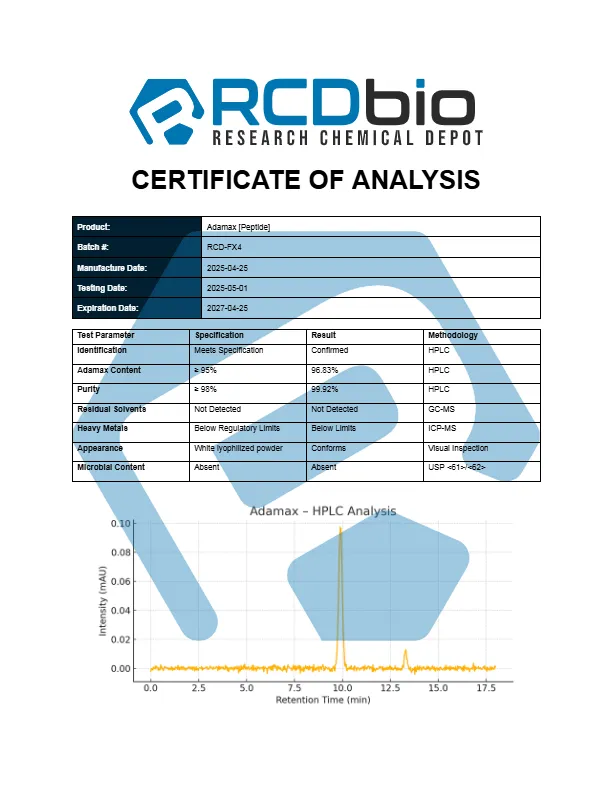
An important data quality note: commercial suppliers, including OP Labs, incorrectly list Adamax with CAS number 80714-61-0 — which is Semax’s CAS — and molecular weight 854.97 g/mol — which is N-Acetyl Semax Amidate’s MW. These values are demonstrably incorrect for Adamax. The correct data, as confirmed by Wikipedia, is C50H69N11O11S, MW 1032.23 g/mol. No dedicated CAS number for Adamax exists in widely published chemical databases. Researchers should verify compound identity from mass spectrometry data in the product’s Certificate of Analysis rather than relying on supplier-listed CAS or formula data.
Adamax is not approved by the Food and Drug Administration for human or veterinary use. It is not a dietary supplement and is not intended for human consumption or therapeutic self-administration. All RCDbio research compounds are supplied strictly for laboratory and research purposes only.
Chemical Properties
| Property | Detail |
| Product Type | Synthetic Nonapeptide / Designer Neuropeptide Analogue (N-Acetyl Semax + Ala-Gly Spacer + Adamantyl C-Terminus) |
| Product Name | Adamax |
| Application | Scientific / Research Use Only |
| CAS Number | No dedicated, widely published CAS for Adamax in verified chemical databases. Multiple suppliers incorrectly list CAS 80714-61-0 (which belongs to Semax) — this is a confirmed data quality error in the commercial supply chain. Verify compound identity via mass spectrometry from the product COA. |
| Molar Mass | 1032.23 g/mol (confirmed Wikipedia SMILES-derived structure; C50H69N11O11S) |
| Chemical Formula | C50H69N11O11S |
| PubChem CID | No confirmed PubChem CID for Adamax in the published database |
| IUPAC Name | Not available in public databases; systematic name derivable from the SMILES structure at Wikipedia. Functionally: N-acetyl-Met-Glu-His-Phe-Pro-Gly-Pro-Ala-Gly-(1-adamantyl)amide |
| Amino Acid Sequence | Ac-Met-Glu-His-Phe-Pro-Gly-Pro-Ala-Gly-NH2 (Ac-MEHFPGPAG-NH2); 9 amino acids; N-terminal acetylation; C-terminal adamantyl amide (not a standard amino acid amide) |
| Structural Components | N-terminal acetyl (Ac-Met): aminopeptidase resistance; MEHFPGP core: Semax pharmacophore (ACTH(4-7) + PGP); Ala-Gly spacer: C-terminal extension; adamantyl amide: carboxypeptidase resistance + CNS penetration hypothesis via adamantane lipophilicity |
| Parent Compounds | Semax (MEHFPGP; CAS 80714-61-0; approved Russia 1996) + P021/Peptide P021 (Ac-DGGLAG-NH2; CAS 1246751-68-7; CNTF-mimetic) — Adamax structurally fuses elements of both |
| Developer | Ceretropic (former Mexico-based research peptide company; designer compound; no academic or pharmaceutical institutional origin) |
| Published Research | No peer-reviewed published research exists for Adamax specifically as of the date of this writing |
| Supplier Data Error | OP Labs and other suppliers list CAS 80714-61-0 (Semax) and MW 854.97 g/mol (N-Acetyl Semax Amidate) — both incorrect for Adamax. Confirmed correct MW: 1032.23 g/mol |
| Synonyms | Adamantyl N-Acetyl Semax; N-Acetyl Semax Adamantyl Amide; Ac-MEHFPGPAG-NH2 |
| Physical Form | Lyophilized white to off-white powder |
| Solubility | Soluble in DMSO; limited aqueous solubility due to adamantyl group; dissolve in DMSO first, then dilute in aqueous buffer |
| Storage (Lyophilized) | −20°C; sealed container; protected from light and moisture |
| Storage (Reconstituted) | 4°C; use within 48–72 hours; avoid repeated freeze-thaw cycles |
| Purity | ≥98% (HPLC verified, independent third-party laboratory analysis) |
| WADA Status | Adamax is not explicitly named on the 2026 WADA Prohibited List. As a non-approved synthetic CNS-active designer peptide, S0 (Non-Approved Substances) provisions may apply in sport-adjacent research contexts. Verify at GlobalDRO.com before use. |
How Does Adamax Work?
No published peer-reviewed mechanistic data exist for Adamax. All mechanism attributions below are inferences from its structural components — the Semax MEHFPGP core and the P021 adamantyl terminus — stated explicitly as inferences throughout.
N-Terminal Acetylation — Aminopeptidase Resistance
The N-terminal acetyl group eliminates the leucine aminopeptidase recognition site, providing resistance to N-terminal exopeptidase degradation identical to the mechanism characterised for N-Acetyl Semax. This modification does not alter the core heptapeptide receptor interaction geometry and is expected to extend plasma and brain tissue stability relative to unmodified Semax.
MEHFPGP Core — BDNF/TrkB Pathway and Melanocortin Interactions — Inferred from Semax Literature
The preserved MEHFPGP heptapeptide core retains the pharmacological interactions characterised for Semax: upregulation of BDNF protein and TrkB phosphorylation in rodent hippocampal preparations [Dolotov et al., 2006], modulation of dopaminergic and serotonergic neurotransmitter systems [Eremin et al., 2005], suppression of proinflammatory cytokine mRNA in ischaemia-reperfusion rodent models [Stavchansky et al., 2021], and melanocortin receptor interactions at MC4/MC5 subtypes. These pathway interactions are attributed to the Semax core and are inferred for Adamax through sequence conservation.
C-Terminal Adamantyl Group — CNS Penetration Hypothesis and P021 Pharmacophore
The 1-adamantyl amide at Adamax’s C-terminus introduces the adamantane cage structure from P021 (Peptide P021) — a synthetic CNTF-mimetic tetrapeptide with characterised BDNF pathway activity in Alzheimer’s disease rodent models. Adamantane (tricyclic cage hydrocarbon, C10H16) is a highly lipophilic, rigid, non-planar structural unit with CNS-penetrating properties well characterised in medicinal chemistry. In Adamax, the adamantyl terminus provides C-terminal carboxypeptidase protection through amide bond formation, and the adamantane cage is hypothesised to enhance membrane permeability and CNS bioavailability relative to Semax and N-Acetyl Semax Amidate. This CNS penetration hypothesis is not supported by published pharmacokinetic data for Adamax specifically — it is a mechanistic inference from adamantane medicinal chemistry principles applied to the compound’s design rationale.
Ala-Gly Spacer — Structural Bridging Element
The Ala-Gly dipeptide spacer between the MEHFPGP core and the adamantyl terminus provides conformational flexibility and spatial separation between the Semax pharmacophore and the adamantyl cage. In P021, the Ala-Gly equivalent spacer is part of the bridging sequence between the CNTF-derived N-terminal region and the adamantyl C-terminus. The specific contribution of the Ala-Gly spacer to Adamax’s activity profile has not been published.
Key Research Findings
No peer-reviewed published research exists for Adamax. The following observations are from the Semax research literature and are inferred as applicable to Adamax through its preserved MEHFPGP core sequence. All are stated as inferences.
- No published Adamax-specific data: As of the date of this writing, no peer-reviewed study has directly characterised Adamax’s pharmacology, pharmacokinetics, receptor binding, in vitro activity, or in vivo activity in any experimental system.
- BDNF/TrkB upregulation (Semax core, inferred): Intranasal Semax in rat hippocampal preparations associated with up to 1.4-fold increase in BDNF protein and 1.6-fold increase in TrkB phosphorylation [Dolotov et al., 2006].
- Dopaminergic/serotonergic modulation (Semax core, inferred): Semax activated dopaminergic and serotonergic brain systems in rodent preparations [Eremin et al., 2005].
- Neuroinflammatory mRNA suppression (Semax core, inferred): Semax is associated with Il1a, Il1b, Il6, Ccl3, and Cxcl2 mRNA suppression in rodent tMCAO ischaemia models [Stavchansky et al., 2021].
- P021 adamantyl terminus BDNF activity (inferred): P021 (CNTF-mimetic tetrapeptide with adamantyl C-terminus) upregulates BDNF and reduces tau hyperphosphorylation in Alzheimer’s disease rodent models — providing the rationale for incorporating the adamantyl terminus into Adamax.
All findings listed above are inferred from Semax and P021 component research. No published peer-reviewed data exists for Adamax. The compound was not developed through peer-reviewed academic or pharmaceutical channels. These inferences do not constitute evidence of Adamax’s efficacy or safety in any experimental system or organism.
What are the Potential Research Applications of Adamax?
In controlled laboratory environments, Adamax is investigated for the following research applications based on its structural composition. These do not constitute established findings for Adamax specifically.
Designer Neuropeptide Stability and SAR Research Adamax represents the endpoint of a hypothetical structural optimisation series — N-Acetyl Semax → N-Acetyl Semax Amidate → Adamax — where progressive C-terminal modification adds first amide protection and then adamantyl cage structure. Research examines how the adamantyl terminus alters plasma stability, lipophilicity, and in vitro membrane penetration relative to other Semax analogues in comparative SAR investigations.
CNS Penetration and BBB Passage Studies Adamax is investigated in blood-brain barrier model preparations (in vitro transwell cell systems, PAMPA membrane assays) to characterise whether the adamantyl terminus increases CNS penetration relative to Semax and N-Acetyl Semax Amidate. Research examines the relationship between adamantane lipophilicity and membrane permeability across CNS barrier model systems.
BDNF Pathway and Neuroplasticity Research Based on the preserved MEHFPGP core, Adamax is investigated in preclinical hippocampal BDNF expression models and TrkB receptor activation assays, examining whether the structural modifications that distinguish Adamax from Semax alter the potency, duration, or regional specificity of BDNF/TrkB pathway modulation.
Semax Analogue Comparative Pharmacology Adamax is employed in comparative studies examining the full Semax analogue series — Semax, N-Acetyl Semax, N-Acetyl Semax Amidate, Adamax — characterising how each structural modification cumulatively alters pharmacokinetic and pharmacodynamic profiles in matched experimental systems.
Novel Neuropeptide Design Research Adamax serves as a model compound for investigating the chemical feasibility and biological consequences of fusing two established neuropeptide pharmacophores (Semax core + P021 adamantyl terminus) in a single synthetic nonapeptide — a research question relevant to designer neuropeptide chemistry and rational CNS peptide design.
What are the Potential Side Effects of Adamax?
No direct toxicity or side effect data for Adamax is available in peer-reviewed literature. All observations below are inferred from Semax preclinical data.
- Generally low acute toxicity profile expected based on the Semax core; Semax demonstrates low acute toxicity in rodent preclinical studies at research-relevant doses
- The adamantyl group increases lipophilicity relative to Semax — lipophilic compounds can produce non-specific membrane interaction effects in cell-based assay systems at concentrations above those relevant to specific pathway engagement; researchers should include concentration-response controls in cell-based protocols
- Limited aqueous solubility due to the adamantyl terminus — aggregation in aqueous media at or above critical concentration may alter the compound’s interaction profile in cell-based assay systems
- No human safety or tolerability data have been established for Adamax. These observations are inferred from Semax preclinical literature and adamantane medicinal chemistry and should not be extrapolated to Adamax or to human or animal outcomes.
Risk & Handling
Handling Precautions
Adamax should only be handled by trained laboratory personnel. Appropriate PPE is required: nitrile gloves, a laboratory coat, and eye protection at a minimum. When working with lyophilized powder, use within a laminar flow cabinet. Avoid aerosol generation during reconstitution. Due to the adamantyl group’s lipophilicity, dissolve initially in DMSO before dilution into an aqueous buffer. Ensure final DMSO concentration in cell-based assays remains ≤0.1% to avoid solvent cytotoxicity.
Exposure Risks
Risk Tier: LOW–MODERATE
Adamax is expected to share the generally low acute toxicity profile of parent Semax. Its CNS-active profile through the MEHFPGP core means accidental systemic exposure may produce CNS pharmacological effects. The adamantyl terminus’s increased lipophilicity may enhance membrane interaction and distribution to lipophilic tissue compartments relative to Semax, potentially altering exposure duration. No human safety data has been established for Adamax.
Storage
- Lyophilized form: Store at −20°C in original sealed, light-protected container with desiccant
- Reconstituted form: Store at 4°C; use within 48–72 hours of reconstitution; dissolve in DMSO stock first, then dilute into buffer
- Do not subject to repeated freeze-thaw cycles; Met1 oxidation risk and adamantyl amide hydrolysis risk both increase with cycling
- Protect from prolonged light and atmospheric oxygen exposure; Met1 residue susceptible to oxidative modification
Frequently Asked Questions
Q: What is Adamax, and how does it differ from Semax? A: Adamax (Ac-MEHFPGPAG-NH2; MW 1032.23 g/mol) is a synthetic nonapeptide designer analogue of Semax, adding three structural modifications: N-terminal acetylation (aminopeptidase resistance, same as N-Acetyl Semax), an Ala-Gly C-terminal spacer extension, and an adamantyl amide C-terminus (carboxypeptidase resistance + proposed CNS penetration enhancement). No peer-reviewed published research exists for Adamax. It was designed by Ceretropic, a former Mexico-based commercial peptide company. It is not approved by the FDA and is intended strictly for laboratory research purposes.
Q: Why do some suppliers list incorrect chemical data for Adamax? A: OP Labs and other suppliers list Adamax with CAS 80714-61-0 and MW 854.97 g/mol — but CAS 80714-61-0 belongs to Semax (MW 813.93 g/mol), and MW 854.97 g/mol belongs to N-Acetyl Semax Amidate. Neither correctly describes Adamax (MW 1032.23 g/mol; C50H69N11O11S; confirmed Wikipedia). No dedicated CAS for Adamax exists in widely published chemical databases. Researchers must verify compound identity via mass spectrometry data from the product COA — supplier-listed CAS and MW for Adamax are unreliable across the research supply chain.
Q: What is the adamantyl group, and why was it incorporated? A: Adamantane (tricyclic cage hydrocarbon C10H16) is a rigid, highly lipophilic non-planar structure used extensively in CNS medicinal chemistry for its membrane-penetrating properties, metabolic stability, and CNS bioavailability enhancement. In Peptide P021 (Ac-DGGLAG-NH2), the adamantyl terminus is the CNTF-mimetic pharmacophore responsible for P021’s BDNF upregulation and tau hyperphosphorylation attenuation in Alzheimer’s disease rodent models. Adamax’s designer rationale combines Semax’s established CNS neuropeptide pharmacology with this adamantyl terminus’s proposed CNS penetration and stability enhancement — though this remains a design hypothesis not yet validated by published pharmacokinetic or pharmacodynamic data.
Q: Is there any published research on Adamax? A: No. As of the date of this writing, no peer-reviewed published study has characterised Adamax’s pharmacology, pharmacokinetics, receptor binding, in vitro activity, or in vivo biological effects in any experimental system. The compound was not developed through peer-reviewed academic or pharmaceutical channels — it was designed and commercially synthesised by Ceretropic. Researchers using Adamax should account for the complete absence of published independent validation when designing protocols and interpreting results.
Q: How should Adamax be dissolved for use in research? A: Due to the adamantyl group’s hydrophobicity, initial dissolution in DMSO is recommended before dilution into aqueous buffer. Dissolve in DMSO to a stock concentration of 10–50 mg/mL, then dilute into PBS or cell culture media to a working concentration. Ensure final DMSO concentration in assay systems remains ≤0.1% to avoid solvent cytotoxicity. Direct aqueous dissolution of concentrated stock solutions may result in aggregation. Confirm complete dissolution before use.
Q: How should Adamax be stored? A: Lyophilized Adamax should be stored at −20°C in a sealed, light-protected container with desiccant. Once reconstituted (preferably in DMSO stock, then diluted), store at 4°C and use within 48–72 hours. The methionine residue at position 1 is susceptible to oxidative modification — minimise oxygen exposure. Repeated freeze-thaw cycles are not recommended.
Related Research Compounds
Researchers investigating Adamax may also be interested in the following compounds currently available for laboratory research at RCDbio:
- Semax — The parent ACTH(4-7)/PGP heptapeptide and the primary published reference compound for all Adamax research; the foundational compound with the largest literature base, including Russian clinical data on which Adamax’s MEHFPGP core activity is based.
- N-Acetyl Semax Amidate — The doubly terminal-protected Semax analogue (Ac-MEHFPGP-NH2); the direct predecessor to Adamax in the Semax modification series; used as the high-stability reference comparator when the Semax core modifications are the research variable.
All products listed are for laboratory and research purposes only.
References
- Dolotov, O. V., Karpenko, E. A., Inozemtseva, L. S., Seredenina, T. S., Levitskaya, N. G., Rozyczka, J., Dubynina, E. V., Novosadova, E. V., Andreeva, L. A., Alfeeva, L. Y., Kamensky, A. A., Grivennikov, I. A., Myasoedov, N. F., & Engele, J. (2006). Semax, an analog of ACTH(4-10) with cognitive effects, regulates BDNF and trkB expression in the rat hippocampus. Brain Research, 1117(1), 54–60. https://pubmed.ncbi.nlm.nih.gov/16996037/
- Eremin, K. O., Kudrin, V. S., Saransaari, P., Oja, S. S., Grivennikov, I. A., Myasoedov, N. F., & Rayevsky, K. S. (2005). Semax, an ACTH(4-10) analogue with nootropic properties, activates dopaminergic and serotonergic brain systems in rodents. Neurochemical Research, 30(12), 1493–1500. https://pubmed.ncbi.nlm.nih.gov/16362768/
- Stavchansky, V. V., Denisova, A. E., Filippenkov, I. B., Sudarkina, O. Y., Gubsky, L. V., Myasoedov, N. F., Limborska, S. A., & Dergunova, L. V. (2021). The Peptide Drug ACTH(4-7)PGP (Semax) Suppresses mRNA Transcripts Encoding Proinflammatory Mediators Induced by Reversible Ischemia of the Rat Brain. Genes, 12(6), 867. https://pubmed.ncbi.nlm.nih.gov/34097675/
- Filippenkov, I. B., Stavchansky, V. V., Denisova, A. E., Yuzhakov, V. V., Sevan’kaeva, L. E., Sudarkina, O. Y., Dmitrieva, V. G., Gubsky, L. V., Myasoedov, N. F., Limborska, S. A., & Dergunova, L. V. (2021). Brain Protein Expression Profile Confirms the Protective Effect of the ACTH(4-7)PGP Peptide (Semax) in a Rat Model of Cerebral Ischemia-Reperfusion. International Journal of Molecular Sciences, 22(12), 6179. https://pubmed.ncbi.nlm.nih.gov/34201112/
Disclaimer
Adamax is exclusively for laboratory research purposes. RCDbio products are not intended to diagnose, prevent, treat, or cure any disease or medical condition.
The Food and Drug Administration has not evaluated the statements on our website. This product is not approved for human or veterinary use. Researchers must comply with all applicable local, state, and federal laws and regulations governing the purchase and use of research compounds. By purchasing, you agree to our Terms and Conditions. RCDbio reserves the right to refuse sales to unauthorized individuals.
ATTENTION: All RCDbio products are strictly for LABORATORY AND RESEARCH PURPOSES ONLY. They are not intended for human consumption, veterinary use, or any other non-research application. For queries, complaints, or support, contact support@rcdbio.co
Reviews
There are no reviews yet