


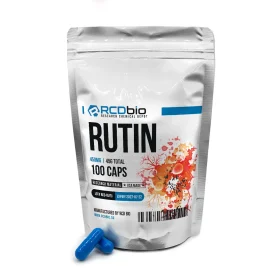
Description
Rutin Capsules
The product is intended for laboratory research use only and not for human consumption.
Available quantities:
- 450 mg per cap / 100ct
Product Information
| Product Name | Rutin Capsules |
|---|---|
| HPLC Purity | 98% |
| Molecular Formula | C27H30O16 |
| Molecular Weight | 610.5 g/mol |
| Synonyms | RUTIN, 153-18-4, rutoside, Quercetin 3-rutinoside, Phytomelin |
| CAS | 153-18-4 |
| IUPAC | 2-(3,4-dihydroxyphenyl)-5,7-dihydroxy-3-[(2S,3R,4S,5S,6R)-3,4,5-trihydroxy-6-[[(2R,3R,4R,5R,6S)-3,4,5-trihydroxy-6-methyloxan-2-yl]oxymethyl]oxan-2-yl]oxychromen-4-one |
| Source | Synthetic |
| Form | Capsule |
| Shelf Life: | 12-24 months under recommended conditions |
Handling and Storage of Rutin Capsules
Rutin is a natural glycoside. For Rutin longevity capsules, it is recommended to store them at room temperature, but for long-term storage, the capsules should be kept at –20°C in tightly sealed and air-free containers to maximize their shelf life. (R)
Lab user exposure: (If opening capsules for analytical testing)
- Avoid prolonged or repeated exposure.
- Avoid inhalation of capsule powder.
- Avoid contact with eyes or skin.
- The product is non-hazardous for lab-to-lab or air transportation.
- Handle inside standard laboratory containment.
- Use gloves, a lab coat, and protective eyewear.
- Use dry containers (polypropylene or glass).
Overview of the Rutin Capsules
Preclinical observations suggest that Rutin is a plant compound, a bioflavonoid that comes from certain vegetables and fruits. (R)
Rutin capsules generally contain a natural flavonoid called rutin, which is known for its role in supporting blood vessels in experimental models. Rutin has also shown antioxidant effects in preclinical research settings. (R)
Additionally, a few studies in laboratory models have indicated that Rutin capsules may have antioxidant and anti-inflammatory properties. (R)
Note: Due to limited research studies, Rutin longevity capsules are not FDA (Food and Drug Administration) approved and only limited to laboratory research compounds.(R)
Working Mechanism of Rutin Capsules
- Preclinical research on experimental models suggests that Rutin capsules may inhibit NF-κB pathways. These pathways may have the potential to reduce the production of pro-inflammatory cytokines such as TNF-α, IL-6, IL-1β, COX-2, and iNOS. (R)
- Additionally, laboratory observations indicate that Rutin compounds potentially modulate AMPK pathways. These pathways may downregulate p38 MAPK and ERK signaling to reduce inflammation at the cellular level in experimental models. (R)
- Different research on various experimental models has indicated that Rutin capsules may work by strengthening blood vessels. Some anecdotal reports have suggested that Rutin capsules may also protect cells from oxidative stress.(R)
Besides potential working mechanisms, the longevity Rutin capsule formulation also has some research observations under laboratory settings:
- May cause diarrhea and mild headache in research models.
- May cause dizziness in some laboratory models.
- May cause gastrointestinal issues in laboratory models.
Residual Solvents
Rutin capsule formulations are purified using solvent extraction and chromatographic techniques. Trace amounts of residual solvents may be present but remain within industry-accepted safety limits. Exact solvent profiles and content can be confirmed by batch-specific COA.
Disclaimer
Rutin capsules are intended exclusively for laboratory research purposes. RCDbio products are not intended to diagnose, treat, cure, or prevent any disease. The Food and Drug Administration has not evaluated the statements on our website. By purchasing, you agree to our Terms and Conditions.
For queries, complaints, or support, please contact support@rcdbio.co.
Reviews
There are no reviews yet