

Description
Section 1 – What is AOD 9604 Nasal Spray?
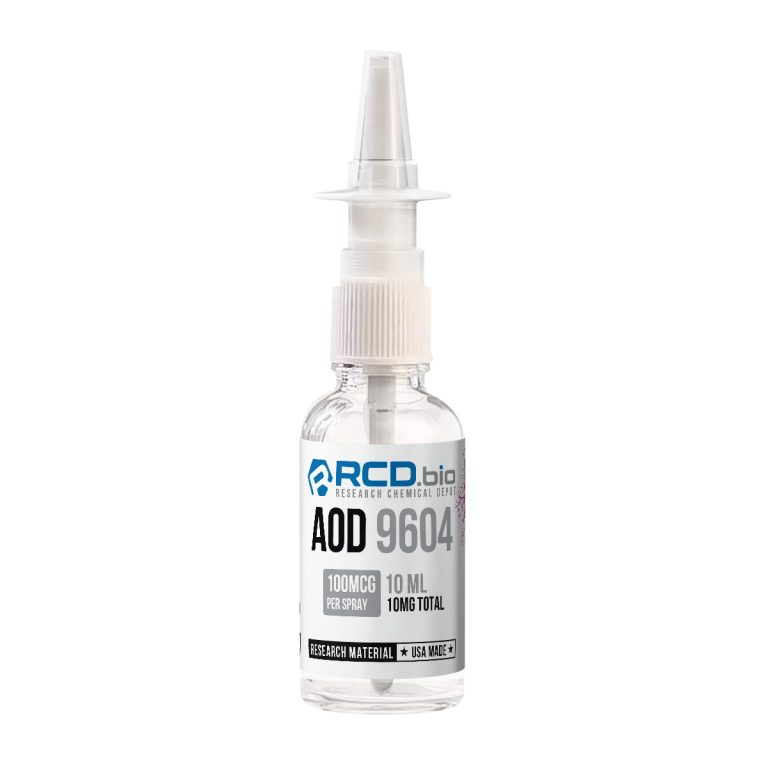
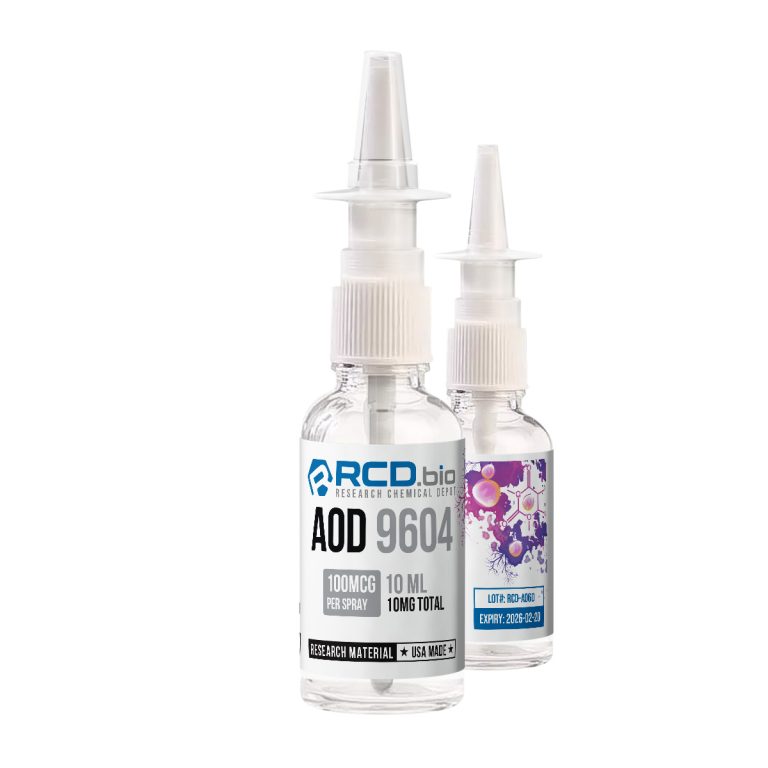
AOD 9604 (Anti-Obesity Drug 9604) is a synthetic peptide research compound comprising a modified 16-amino-acid sequence corresponding to residues 176–191 of human growth hormone (hGH), with the addition of a tyrosine residue at the N-terminus to enhance stability. The compound was originally developed by researchers at Monash University, Australia, in the late 1990s as part of an investigation into the lipolytic domain of hGH. Structurally, AOD 9604 retains the C-terminal disulfide-bonded fragment of hGH that encompasses the region implicated in fat metabolism, while lacking the N-terminal sequences responsible for the somatogenic and diabetogenic actions of intact growth hormone. AOD 9604 has not been approved as a registered pharmaceutical in any jurisdiction; it was investigated as an anti-obesity drug candidate in clinical development but did not achieve regulatory approval. The research-grade nasal spray formulation supplied by RCDbio is not a pharmaceutical product and is not approved for any use outside laboratory research contexts.
In preclinical model systems, AOD 9604 has been investigated primarily in the context of lipid metabolism, with particular attention to adipose tissue lipolysis and lipogenesis inhibition. Research using obese and lean rodent models has examined interactions between AOD 9604 and beta-3 adrenergic receptor (β3-AR) signalling pathways in white and brown adipose tissue. Additional preclinical inquiry has explored the compound’s potential influence on hormone-sensitive lipase (HSL) phosphorylation and on chondrocyte and osteocyte biology in particular models.
The nasal spray formulation is investigated as a delivery route in preclinical research contexts, based on evidence of olfactory bulb-mediated CNS transport for peptide compounds administered intranasally in rodent models. Intranasal delivery has been studied for its potential to bypass hepatic first-pass metabolism and enhance CNS bioavailability relative to systemic routes in preclinical pharmacokinetic models. The nasal mucosa’s proximity to the central nervous system via the olfactory nerve makes it a research-relevant delivery route for CNS-active research compounds.
AOD 9604 Nasal Spray is not approved by the Food and Drug Administration for human or veterinary use. This product is not a dietary supplement and is not intended for human consumption or therapeutic self-administration. All RCDbio research compounds are supplied strictly for laboratory and research purposes only.
Section 2 – Chemical Properties
| Property | Detail |
| Product Type | Synthetic hGH C-terminal fragment peptide – Nasal Spray Research Formulation |
| Product Name | AOD 9604 Nasal Spray |
| Application | Scientific / Research Use Only |
| CAS Number | 221231-10-3 |
| Molar Mass | 1815.10 g/mol (free peptide); AOD 9604 acetate salt: 1875.13 g/mol (C80H127N23O25S2) |
| Chemical Formula | C78H123N23O23S2 (free peptide) |
| IUPAC Name | (2S)-2-[[2-[[(4R,7S,13S,16S,19S,22S,25R)-25-[[(2S)-5-amino-2-[[(2S)-2-[[(2S,3S)-2-[[(2S)-2-[[(2S)-2-[[(2S)-2-amino-3-(4-hydroxyphenyl)propanoyl]amino]-4-methylpentanoyl]amino]-5-carbamimidamidopentanoyl]amino]-3-methylpentanoyl]amino]-3-methylbutanoyl]amino]-5-oxopentanoyl]amino]-22-(3-carbamimidamidopropyl)-13-(2-carboxyethyl)-7,19-bis(hydroxymethyl)-6,9,12,15,18,21,24-heptaoxo-16-propan-2-yl-1,2-dithia-5,8,11,14,17,20,23-heptazacyclohexacosane-4-carbonyl]amino]acetyl]amino]-3-phenylpropanoic acid |
| Synonyms | AOD-9604; AOD9604; Tyr-hGH Frag 176–191; Tyr-somatostatin (177–191); YLRIVQCRSVEGSCGF |
| Physical Form (Compound) | Lyophilized white to off-white powder (compound); supplied as aqueous nasal spray solution |
| Solubility | Soluble in sterile water or aqueous buffered solutions at ≥1 mg/mL |
| Storage (Lyophilized) | −20°C; sealed container; protected from light and moisture |
| Storage (In-Use Spray) | 2–8°C; use within 28 days of first use; DO NOT FREEZE; protect from light |
| PubChem CID | 71300630 (free peptide); 156599045 (acetate salt) |
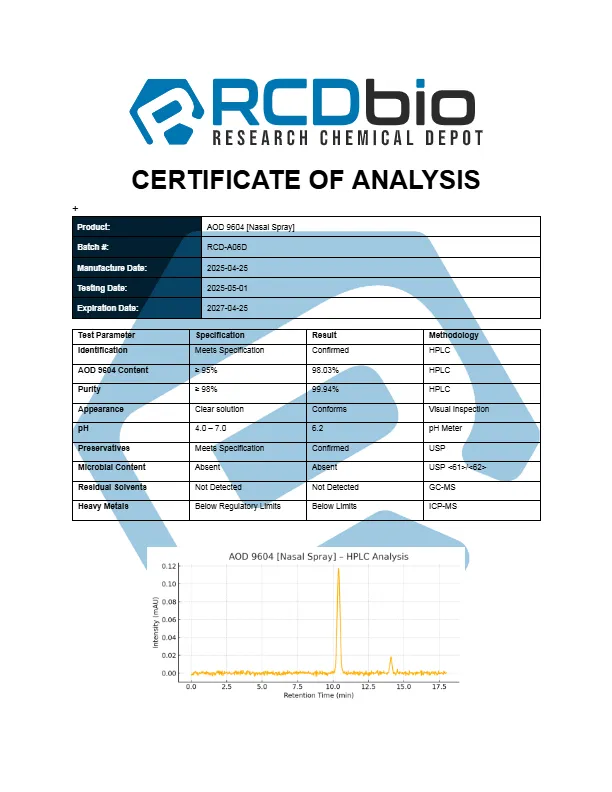
| Purity | ≥98% (HPLC verified, independent third-party laboratory analysis) |
| WADA Status | Explicitly prohibited – named under S2.2.3 (Growth Hormone Fragments) of the 2026 WADA Prohibited List: “growth hormone fragments, e.g. AOD-9604 and hGH 176-191.” Prohibited in- and out-of-competition. Verify current status at GlobalDRO.com. |
| Formulation Vehicle | Sterile phosphate-buffered saline (PBS); preservative-free formulation |
| Spray Volume | 100 mcL per actuation |
| In-Use Shelf Life | 28 days from first use at 2–8°C |
Section 2b – Formulation & Delivery Properties
| Property | Detail |
| Product Form | Nasal spray solution for laboratory research use |
| Delivery Route | Intranasal (IN); systemic absorption via nasal mucosa investigated in preclinical models; metabolic (non-CNS) compound – peripheral absorption pathway primary |
| Spray Volume | 100 mcL per actuation |
| Active Concentration | 100 mcg per actuation (1 mg/mL) |
| Buffer / Vehicle | Sterile phosphate-buffered saline (PBS); pH 6.5–7.5 |
| Preservatives | Preservative-free formulation |
| Container | Amber HDPE nasal spray bottle; 10 mL capacity |
| Sealed Shelf Life | 12 months from manufacturing date at 2–8°C |
| In-Use Shelf Life | 28 days from first actuation at 2–8°C |
| Sterility | Sterile-filtered (0.22 μm membrane) |
| pH | 6.5–7.5 |
| Freeze Warning | DO NOT freeze the ready-to-use nasal spray solution. Freezing alters pH, buffer stability, and spray actuation properties. |
| Intranasal Bioavailability | Specific intranasal bioavailability data for AOD 9604 is not established in published literature. AOD 9604 is a peripherally-acting lipolytic peptide; intranasal delivery in this context is investigated as a non-invasive systemic absorption route via nasal mucosal vasculature rather than for CNS-specific targeting. Nasal mucosal absorption of peptide compounds in the 1–2 kDa molecular weight range has been characterised in preclinical rodent models. |
Section 3 – How Does AOD 9604 Work?
AOD 9604 has been investigated in preclinical models as a selective modulator of adipose tissue lipid metabolism. Its mechanistic profile is characterised by apparent dissociation from the somatogenic signalling cascade of intact hGH – specifically, the compound does not interact with the growth hormone receptor (GHR) in a manner that stimulates IGF-1 production or promotes tissue growth in preclinical preparations. The primary research interest lies in its putative interactions with adipocyte-specific signalling pathways that regulate fat mobilisation and storage.
β3-Adrenergic Receptor Pathway Modulation
The most extensively characterised mechanism in AOD 9604 preclinical research involves the beta-3 adrenergic receptor (β3-AR) signalling pathway in white and brown adipose tissue. Studies using obese mouse models demonstrated that both intact hGH and AOD 9604 were associated with restoration of β3-AR mRNA expression levels in obese adipose tissue to levels approximating those in lean controls [Heffernan et al., 2001]. In β3-AR knockout mouse preparations, the lipolytic and body weight effects observed in wild-type obese animals were substantially attenuated, implicating β3-AR as a critical mediator of AOD 9604’s observed lipolytic activity in these models [Heffernan et al., 2001]. β3-AR activation in adipocytes initiates a signalling cascade via adenylyl cyclase, leading to elevated intracellular cyclic AMP (cAMP) and downstream phosphorylation of hormone-sensitive lipase (HSL), the principal enzyme catalysing triglyceride hydrolysis in adipocytes.
Hormone-Sensitive Lipase (HSL) Activation and Lipolysis
In isolated adipocyte preparations and intact adipose tissue models, AOD 9604 exposure has been associated with increased lipolytic activity, characterised by elevated release of free fatty acids and glycerol – the biochemical products of HSL-mediated triglyceride hydrolysis [Ng et al., 2000]. This lipolytic action appears to be independent of the GH receptor’s somatogenic pathway, based on evidence that the compound does not elevate circulating IGF-1 or alter insulin sensitivity indices in rodent models at lipolytic doses [Heffernan et al., 2001]. The precise receptor binding partner for AOD 9604’s lipolytic initiation remains an active area of inquiry in preclinical receptor mapping studies.
Lipogenesis Inhibition
In vitro studies using isolated adipocyte preparations have examined whether AOD 9604 modulates de novo lipogenesis – the anabolic pathway by which non-lipid substrates are converted to fatty acids and stored as triglycerides. Observations from these preparations suggest potential inhibitory effects on lipogenic enzyme activity, though the molecular targets of this inhibitory action have not been fully characterised in the published literature [Heffernan et al., 2001]. The combination of apparent pro-lipolytic and anti-lipogenic activity in preclinical models is the basis for research interest in AOD 9604 as a tool compound for studying fat metabolism in isolation from broader GH-axis effects.
Independence from Somatogenic and Insulin/IGF-1 Pathways
A key mechanistic feature distinguishing AOD 9604 from intact hGH in preclinical models is its apparent failure to stimulate insulin resistance or elevate IGF-1 at doses associated with lipolytic activity. Rodent studies examining chronic administration have reported that body composition changes attributed to AOD 9604 were not accompanied by alterations in fasting blood glucose, insulin levels, or IGF-1 concentrations [Heffernan et al., 2001]. This dissociation makes AOD 9604 a useful tool compound for investigating the lipolytic component of growth hormone biology independently of its anabolic endocrine effects.
Section 3b – Intranasal Delivery & Pharmacokinetics
Olfactory Bulb-Mediated CNS Transport
When administered intranasally in preclinical rodent model systems, peptide compounds can access the central nervous system through the olfactory nerve (cranial nerve I) pathway. Compounds deposited on the olfactory mucosa are transported along olfactory axons through the cribriform plate to the olfactory bulb, from which access to deeper CNS structures has been characterised in rodent preparations. It should be noted that AOD 9604 is a peripherally-acting lipolytic compound; its primary site of action in preclinical studies has been adipose tissue rather than CNS structures. Intranasal delivery of AOD 9604 in research contexts is therefore investigated principally as a non-invasive route for systemic absorption via the nasal mucosal vasculature, rather than for CNS-targeted delivery. The olfactory transport pathway has been characterised for structurally related hGH-derived peptide fragments in preclinical rodent model systems [Maigler et al., 2021].
Hepatic First-Pass Metabolism Bypass
The intranasal route avoids portal circulation and hepatic first-pass metabolic processing. For peptide research compounds subject to rapid proteolytic degradation in the gastrointestinal environment, intranasal delivery has been investigated as a route that may preserve compound integrity relative to oral administration in preclinical pharmacokinetic models. AOD 9604, as a 16-amino-acid disulfide-bonded peptide, is subject to proteolytic degradation in the gastrointestinal environment, which limits oral bioavailability. The intranasal route bypasses this degradation pathway. These observations are derived from preclinical studies and do not constitute evidence of efficacy via any route in human subjects.
Nasal Mucosal Absorption
AOD 9604 has a molecular weight of approximately 1,815 Da (1.8 kDa), placing it within the range associated with paracellular and endocytic pathways as the likely predominant absorption mechanisms at the nasal mucosa. At this molecular weight, transcellular diffusion is less favoured relative to smaller lipophilic compounds (<1 kDa). Paracellular absorption via tight junction pathways and endocytic uptake at the mucosal surface are the primary mechanisms characterised for peptides in this molecular weight range in preclinical models. The disulfide bond within AOD 9604’s cyclic structure may further influence its mucosal permeability profile relative to linear peptides of comparable molecular weight.
Compound-Specific Pharmacokinetics
Specific intranasal pharmacokinetic data for AOD 9604 in standardised preclinical models is not available in the published literature as of June 2026. Published pharmacokinetic data for AOD 9604 pertains primarily to intravenous, subcutaneous, and oral routes in rodent and human studies conducted during clinical development. Plasma half-life in these models is reported as approximately 20–30 minutes following subcutaneous administration, with rapid proteolytic clearance. Researchers should account for the absence of compound-specific intranasal pharmacokinetic data when designing laboratory protocols involving the nasal spray formulation.
Section 4 – Key Research Findings
- Lipolysis (obese mouse model): Chronic AOD 9604 administration in obese mouse preparations was associated with reduced body fat accumulation without measurable effects on IGF-1 or insulin sensitivity indices [Heffernan et al., 2001; PMID: 11713213].
- β3-AR pathway (knockout model): In β3-AR knockout mouse preparations, AOD 9604-associated lipolytic and body weight effects were substantially attenuated compared to wild-type controls, implicating β3-AR signalling [Heffernan et al., 2001; PMID: 11713213].
- Lipogenesis (in vitro adipocyte): In isolated adipocyte preparations, AOD 9604 exposure was associated with inhibited de novo lipogenic enzyme activity relative to vehicle-treated controls [Ng et al., 1990; PMID: 9548616].
- Articular cartilage (rabbit intra-articular model): Intra-articular injection of AOD 9604 with and without hyaluronic acid was associated with histological changes in cartilage preparations in a rabbit osteoarthritis model [Kwon & Park, 2015; PMID: 26275694].
- GH receptor independence (rodent): AOD 9604 did not produce measurable growth-promoting or IGF-1-elevating effects in rodent models at doses associated with observed lipolytic activity, consistent with GH receptor somatogenic pathway bypass [Heffernan et al., 2001; PMID: 11713213].
All findings listed above are derived from preclinical or in vitro data. No human clinical trial data has been established for AOD 9604 nasal spray. These observations do not constitute evidence of efficacy or safety in any human condition or organism.
Section 5 – What are the Potential Research Applications?
In controlled laboratory environments, AOD 9604 nasal spray has been investigated for the following research applications. These are observed in preclinical and in vitro contexts only and do not constitute claims of efficacy or safety in any organism.
Adipose Tissue Lipid Metabolism Research
AOD 9604 has been used as a tool compound in preclinical models of adipose tissue lipolysis to investigate the downstream consequences of β3-AR pathway activation in white and brown adipocyte preparations. In obese rodent models, it has been employed to study the relationship between β3-AR mRNA expression, HSL phosphorylation, and net triglyceride hydrolysis in primary adipocyte cultures and intact adipose tissue explants. Researchers studying lipid flux and fatty acid mobilisation in disease-relevant metabolic states have used AOD 9604 to isolate the lipolytic component of growth hormone signalling from concurrent somatogenic effects.
Obesity and Metabolic Syndrome Preclinical Modelling
In rodent models of diet-induced and genetic obesity, AOD 9604 has been employed to study the relationship between adipose β3-AR signalling, fat depot distribution, and body composition changes in the absence of measurable insulin or IGF-1 confounds. The compound’s apparent selectivity for lipolytic over somatogenic pathways makes it a useful comparator compound in pharmacological studies designed to dissect the metabolic actions of growth hormone or its fragments in adipose tissue.
In Vitro Lipogenesis Inhibition Studies
AOD 9604 has been applied in isolated adipocyte and cell line preparations to examine inhibitory effects on de novo lipogenesis enzyme cascades. These in vitro models have been used to characterise the dose-dependency of lipogenesis suppression and to explore potential interactions with lipogenic transcription factors and enzyme systems in metabolically active adipocyte preparations.
Articular Cartilage and Bone Biology Research
Preclinical inquiry has employed AOD 9604 in intra-articular injection models to examine its interactions with chondrocyte and osteoblast biology in articular preparations. Studies in rabbit osteoarthritis models have evaluated histological and biomechanical parameters in cartilage explants following AOD 9604 administration, both alone and in combination with hyaluronic acid formulations. These investigations position AOD 9604 as a tool compound for studying peptide-mediated effects in connective tissue model systems.
Section 6 – What are the Potential Side Effects?
Researchers in preclinical and in vitro settings have noted the following observations. Long-term safety and toxicity profiles remain incompletely characterised, and no human safety data has been established.
- Injection site reactions (subcutaneous rodent models): Transient local inflammatory responses at the site of subcutaneous administration were noted in some rodent chronic dosing studies; relevance to nasal spray formulation and mucosal delivery route has not been characterised.
- Absence of measurable endocrine disruption (rodent): Chronic AOD 9604 administration in obese and lean rodent models did not produce measurable alterations in fasting insulin, blood glucose, or IGF-1 in published preclinical studies; however, comprehensive endocrine panels were not uniformly reported across all studies.
- Mucosal tolerability (intranasal route): No published compound-specific mucosal tolerability data for AOD 9604 nasal spray formulations has been identified in the peer-reviewed literature as of June 2026. Nasal mucosal tolerability for peptide formulations at comparable concentrations has been characterised for structurally related compounds in rodent models; extrapolation to AOD 9604 is not established.
- Absence of carcinogenicity data: Long-term carcinogenicity studies specific to AOD 9604 are not available in the published literature. Researchers using this compound in cell proliferation or tumour biology model systems should design appropriate controls to account for the absence of this data.
- Formulation vehicle interactions: Researchers employing the nasal spray formulation in cell-based assay systems should be aware of potential contributions from the phosphate-buffered saline vehicle to experimental outcomes; appropriate vehicle-only controls are recommended.
No human safety or tolerability data has been established for AOD 9604 nasal spray. These observations are derived from experimental systems and should not be extrapolated to human or animal outcomes.
Section 7 – Risk & Handling
A – Handling Precautions
Researchers handling AOD 9604 Nasal Spray should observe standard laboratory personal protective equipment protocols, including nitrile gloves, laboratory coat, and eye protection. The following nasal spray-specific precautions are mandatory:
Do not direct the nasal spray actuator toward the face, eyes, or mucous membranes during handling, testing, or transfer. AOD 9604 is a biologically active peptide and may produce pharmacological effects via inadvertent intranasal self-exposure.
Handle the nasal spray solution in a clean laboratory environment. For aliquoting or analytical sampling, use a laminar flow cabinet.
The nasal spray solution is an aqueous formulation susceptible to microbial contamination if compromised. Handle under aseptic conditions. Discard if the solution appears cloudy, discoloured, or shows particulate matter.
Avoid aerosol generation during any manipulation of the nasal spray solution.
B – Exposure Risks
Risk Tier: LOW–MODERATE
Published preclinical toxicology data for AOD 9604 does not indicate significant acute toxicity at doses used in fat metabolism research models. No genotoxicity, mutagenicity, or systemic organ toxicity findings were reported in the preclinical studies that supported clinical development investigation. However, long-term toxicology data are limited, and carcinogenicity studies specific to AOD 9604 are absent from the published literature. No human safety or tolerability data has been established for AOD 9604 nasal spray. Researchers should handle this compound with appropriate precautions consistent with an incompletely characterised preclinical safety profile.
C – Storage
Sealed nasal spray (in-use): Store at 2–8°C; use within 28 days of first actuation; protect from light.
DO NOT FREEZE the ready-to-use nasal spray formulation. Freezing alters pH, buffer stability, excipient integrity, and spray actuation properties.
Lyophilized bulk/stock (if applicable): Store at −20°C in a sealed, desiccated, light-protected container. Long-term storage at −80°C is recommended for extended stability.
Discard reconstituted or in-use nasal spray solution if it appears cloudy, discoloured, or shows particulate matter.
Section 8 – FAQs
Q: How does intranasal administration facilitate systemic delivery of AOD 9604 in preclinical research models?
A: AOD 9604 is a peripherally-acting lipolytic peptide compound; its primary site of action in preclinical studies has been adipose tissue rather than CNS structures. Intranasal delivery is investigated in research contexts as a non-invasive route for systemic absorption via the nasal mucosal vasculature, bypassing gastrointestinal proteolysis and hepatic first-pass metabolism. The nasal mucosa is highly vascularised, and peptide compounds in the 1–2 kDa molecular weight range may access the systemic circulation via paracellular and endocytic mucosal pathways in preclinical models. Additionally, olfactory nerve (CN I)-mediated transport to CNS structures has been characterised for peptide compounds in rodent models, though AOD 9604-specific CNS delivery data have not been established in published literature. No human CNS delivery or systemic bioavailability data has been established for research-grade AOD 9604 nasal spray.
Q: What is the recommended storage and in-use shelf life for AOD 9604 nasal spray?
A: The sealed nasal spray formulation should be stored at 2–8°C and is stable for 12 months from the manufacturing date under these conditions. Once the bottle has been first actuated, the in-use shelf life is 28 days at 2–8°C. DO NOT FREEZE the ready-to-use nasal spray solution; freezing disrupts pH, buffer stability, and spray actuation performance. Protect from direct light at all times. Lyophilized bulk stock, where applicable, should be stored at −20°C in a sealed, desiccated container. Discard any solution that appears cloudy, discoloured, or contains visible particulate matter.
Q: Is the AOD 9604 nasal spray formulation suitable for use in cell culture or in vitro assay systems?
A: The nasal spray formulation is prepared in sterile phosphate-buffered saline (PBS) at pH 6.5–7.5 and contains no added preservatives, which reduces cytotoxicity concerns associated with preservative-containing formulations (e.g., benzyl alcohol). However, researchers should validate the formulation vehicle’s compatibility with their specific cell lines or primary cell preparations prior to use, as the PBS buffer composition and peptide concentration may require dilution to avoid osmotic effects in sensitive cell culture systems. Appropriate vehicle-only controls using equivalent volumes of PBS are recommended for all in vitro experiments. Researchers should prepare working solutions from stock aliquots under aseptic conditions to maintain sterility.
Q: What is the plasma half-life of AOD 9604 in preclinical pharmacokinetic models?
A: Published pharmacokinetic data for AOD 9604 pertains to intravenous, subcutaneous, and oral routes in rodent and human subjects enrolled in clinical development studies. Following subcutaneous administration in rodent models, plasma half-life has been reported in the range of approximately 20–30 minutes, reflecting rapid proteolytic clearance consistent with an unmodified peptide of this molecular weight. Specific intranasal pharmacokinetic data – including Tmax, Cmax, and systemic bioavailability via the nasal spray route – are not available in the published literature as of June 2026. Researchers should account for this data gap when designing dosing protocols for nasal spray research applications.
Q: What is the WADA status of AOD 9604?
A: AOD 9604 is explicitly named on the 2026 WADA Prohibited List under category S2.2.3 (Growth Hormone Fragments): “growth hormone fragments, e.g. AOD-9604 and hGH 176-191.” The substance is prohibited both in- and out-of-competition. Research institutions conducting studies involving athletes or working within anti-doping frameworks should be aware of this status. Researchers are advised to verify current anti-doping status at GlobalDRO.com. RCDbio supplies AOD 9604 nasal spray exclusively for laboratory research purposes.
Q: How does the nasal spray formulation of AOD 9604 differ from injectable vial preparations?
A: The nasal spray formulation presents AOD 9604 as a pre-constituted sterile aqueous solution in a metered-dose delivery device, designed for intranasal application in research settings. Injectable vial preparations are supplied as lyophilized powder requiring reconstitution with bacteriostatic or sterile water prior to use, and are formulated for subcutaneous or intravenous administration in preclinical models. The nasal spray eliminates the reconstitution step and delivers a fixed dose per actuation (100 mcg per 100 mcL spray). The PBS vehicle, pH range, and preservative-free specification of the nasal spray formulation differ from injectable preparations, which may employ different buffers or bacteriostatic agents. Researchers should not substitute one formulation type for the other without validation of equivalency for their specific experimental system.
Q: What toxicity observations have been reported for AOD 9604 in preclinical studies?
A: Published preclinical toxicology data for AOD 9604 does not indicate significant acute systemic toxicity at doses used in fat metabolism research. Phase I clinical investigation in human subjects reported a generally well-tolerated profile for the compound at single doses; however, this data pertains to injectable administration routes and cannot be extrapolated to the nasal spray formulation or to research use outside clinical trial settings. Long-term carcinogenicity, reproductive toxicity, and chronic organ toxicity data specific to AOD 9604 are not comprehensively reported in the available literature. No human safety or tolerability data has been established specifically for AOD 9604 nasal spray as a research formulation.
Section 9 – Related Research Compounds
Researchers investigating AOD 9604 nasal spray may also be interested in the following compounds currently available for laboratory research at RCDbio:
- HGH Fragment 176-191 Peptide – The unmodified hGH C-terminal fragment (without N-terminal tyrosine), used as a comparator compound in preclinical studies of growth hormone lipolytic domain biology.
- Ipamorelin Nasal Spray – A selective growth hormone secretagogue investigated in preclinical models for pituitary GH release via ghrelin receptor (GHSR-1a) agonism, providing a complementary tool for GH-axis research.
- Sermorelin Nasal Spray – A synthetic analogue of growth hormone-releasing hormone (GHRH) investigated in preclinical rodent models for stimulation of endogenous GH secretion via GHRH receptor activation.
All products listed are for laboratory and research purposes only.
Section 10 – References
Research transparency note: No peer-reviewed publications specific to intranasal delivery pharmacokinetics of AOD 9604 are available as of June 2026. References 1 and 2 are the primary compound-specific mechanistic studies. Reference 3 relates to intranasal peptide delivery pharmacology characterised in preclinical rodent models. Reference 4 is the articular cartilage model study.
- Heffernan, M., Summers, R. J., Thorburn, A., Ogru, E., Gianello, R., Jiang, W. J., & Ng, F. M. (2001). The effects of human GH and its lipolytic fragment (AOD9604) on lipid metabolism following chronic treatment in obese mice and beta(3)-AR knock-out mice. Endocrinology, 142(12), 5182–5189. https://pubmed.ncbi.nlm.nih.gov/11713213/
- Ng, F. M., Sun, J., Sharma, L., Libinaka, R., Jiang, W. J., & Gianello, R. (1990). Metabolic studies of a synthetic lipolytic domain (AOD9604) of human growth hormone. Hormone Research, 33(1), 29–36. https://pubmed.ncbi.nlm.nih.gov/9548616/
- Maigler, F., Ladel, S., Flamm, J., Gänger, S., Kurpiers, B., Kiderlen, S., Völk, R., Hamp, C., Hartung, S., Spiegel, S., Soleimanizadeh, A., Eberle, K., Hermann, R., Krainer, L., Pitzer, C., & Schindowski, K. (2021). Selective CNS Targeting and Distribution with a Refined Region-Specific Intranasal Delivery Technique via the Olfactory Mucosa. Pharmaceutics, 13(11), 1904. https://pubmed.ncbi.nlm.nih.gov/34834319/
- Kwon, D. R., & Park, G. Y. (2015). Effect of Intra-articular Injection of AOD9604 with or without Hyaluronic Acid in Rabbit Osteoarthritis Model. Annals of Clinical and Laboratory Science, 45(4), 426–432. https://pubmed.ncbi.nlm.nih.gov/26275694/
Section 11 – Disclaimer + ATTENTION Block
AOD 9604 Nasal Spray is exclusively for laboratory research purposes. RCDbio products are not intended to diagnose, prevent, treat, or cure any disease or medical condition.
The Food and Drug Administration has not evaluated the statements on our website. This product is not approved for human or veterinary use. Researchers must comply with all applicable local, state, and federal laws and regulations governing the purchase and use of research compounds. By purchasing, you agree to our Terms and Conditions. RCDbio reserves the right to refuse sales to unauthorized individuals.
ATTENTION: All RCDbio products are strictly for LABORATORY AND RESEARCH PURPOSES ONLY. They are not intended for human consumption, veterinary use, or any other non-research application. For queries, complaints, or support, contact support@rcdbio.co
Reviews
There are no reviews yet