

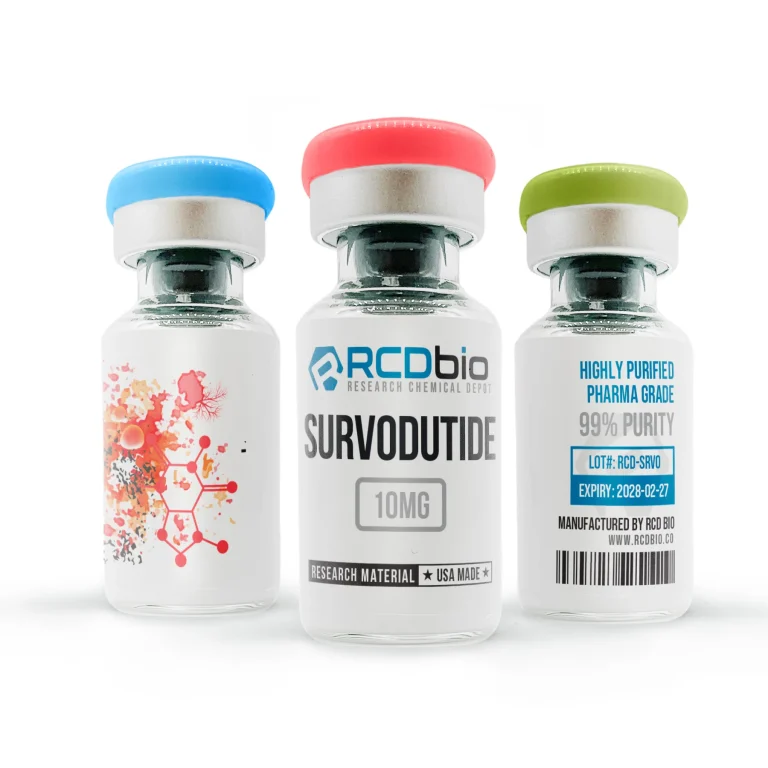
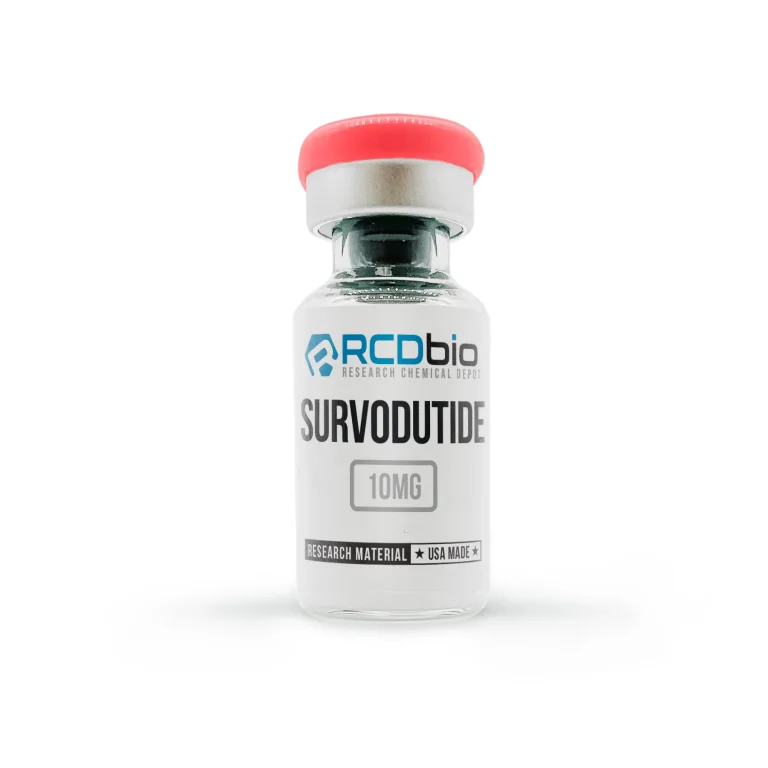
Description
What is Survodutide?
Survodutide (BI 456906) is a synthetic 29-amino acid peptide developed by Zealand Pharma and licensed to Boehringer Ingelheim, classified as a dual glucagon receptor / glucagon-like peptide-1 receptor (GCGR/GLP-1R) agonist. Its sequence is based on a glucagon backbone — distinct from GIP-backbone-derived compounds such as Tirzepatide and Retatrutide — with specific residue substitutions engineered for dual receptor activity and pharmacokinetic optimisation. Key structural features include a non-coded amino acid, 1-aminocyclobutane-1-carboxylic acid (Ac4c), at position 2 to confer DPP-4 resistance; substitutions at positions 18, 20, 23, and 16 from the glucagon sequence to GLP-1 and exendin-4 equivalents to optimise GLP-1R engagement; and additional modifications at positions 24 and 27–29. A C18 fatty diacid moiety is conjugated at position 24 (lysine) via a hydrophilic linker to enable albumin binding and once-weekly dosing. In receptor activation assays in CHO-K1 cell preparations, Survodutide demonstrates an EC50 of 0.52 nM at GCGR and 0.33 nM at GLP-1R — providing full GLP-1R activation and partial GCGR activation at predicted therapeutic exposures.
Survodutide represents a mechanistically distinct class of incretin therapeutic compared to GLP-1R monoagonists (semaglutide) and dual GLP-1R/GIPR agonists (tirzepatide): by pairing GLP-1R engagement with GCGR agonism rather than GIPR agonism, Survodutide is hypothesised to combine appetite reduction (GLP-1R) with increased energy expenditure and hepatic fatty acid oxidation (GCGR) — a combination thought to be particularly relevant for MASH treatment given glucagon’s direct hepatic effects. Phase 3 SYNCHRONIZE programme results for both obesity (SYNCHRONIZE-1) and MASLD (SYNCHRONIZE-MASLD) were presented at the American Diabetes Association 2026 Scientific Sessions on June 7, 2026 and simultaneously published in the New England Journal of Medicine and Nature Medicine, respectively — confirming Survodutide’s potential as a best-in-class MASH treatment candidate.
Survodutide has not received FDA approval for any indication as of June 2026. Regulatory submissions are anticipated following the SYNCHRONIZE programme data. It has received FDA Breakthrough Therapy designation for MASH, FDA Fast Track designation, EMA PRIME designation, and China NMPA Breakthrough Therapy designation. Research-grade Survodutide from RCDbio is not a pharmaceutical product and is not approved or intended for any human therapeutic use. It is not a dietary supplement and is not intended for human consumption or self-administration. All RCDbio research compounds are supplied strictly for laboratory and research purposes only.
Chemical Properties
| Property | Detail |
| Product Type | Synthetic Dual GCGR/GLP-1R Agonist Peptide (Glucagon-Backbone) |
| Product Name | Survodutide (BI 456906) |
| Application | Scientific / Research Use Only |
| CAS Number | 2805997-46-8 |
| Molar Mass | 4231.692 g/mol |
| Chemical Formula | C192H289N47O61 |
| PubChem CID | 168429725 |
| IUPAC Name | Full canonical IUPAC available on PubChem CID 168429725; 29-residue glucagon-backbone peptide with Ac4c at position 2, GLP-1/exendin-4 substitutions at positions 16/18/20/23, and C18 fatty diacid via hydrophilic linker at Lys24 |
| Amino Acid Count | 29 amino acids (glucagon backbone with multiple substitutions; non-coded Ac4c at position 2) |
| Key Modifications | Ac4c at position 2: DPP-4 resistance; residue substitutions at positions 16, 18, 20, 23 (GLP-1/exendin-4 equivalents for GLP-1R engagement); C18 fatty diacid via hydrophilic linker at Lys24: albumin binding, once-weekly half-life |
| Receptor Targets | GCGR (EC50: 0.52 nM, CHO-K1 cell assay); GLP-1R (EC50: 0.33 nM, CHO-K1 cell assay); partial GCGR / full GLP-1R activation at predicted therapeutic exposures |
| Structural Distinction | Glucagon-backbone dual agonist — mechanistically distinct from GIP-backbone compounds (Tirzepatide, Retatrutide); pairs GLP-1R appetite suppression with GCGR energy expenditure/hepatic effects |
| Synonyms | BI 456906; BI456906; EX-A7878; Survodutide |
| Developer | Discovered by Zealand Pharma; licensed to Boehringer Ingelheim for global development and commercialisation |
| Regulatory Status | Not FDA approved as of June 2026. FDA Breakthrough Therapy (MASH), Fast Track designations; EMA PRIME; NMPA China Breakthrough Therapy. Phase 3 SYNCHRONIZE-1 and SYNCHRONIZE-MASLD topline results announced April 28, 2026; full data presented at ADA 2026 Scientific Sessions, June 2026 |
| Physical Form | Lyophilized white to off-white powder |
| Solubility | Soluble in sterile water and PBS; compatible with standard peptide reconstitution buffers |
| Storage (Lyophilized) | −20°C; sealed container; protected from light and moisture |
| Storage (Reconstituted) | 4°C; use within 48–72 hours; avoid repeated freeze-thaw cycles |
| Purity | ≥98% (HPLC verified, independent third-party laboratory analysis) |
| WADA Status | Survodutide is not approved for any therapeutic use as of June 2026 and falls under S0 (Non-Approved Substances) of the 2026 WADA Prohibited List. Its GLP-1R agonist component may also invoke GLP-1R class monitoring considerations. Verify current status at GlobalDRO.com before use. |
How Does Survodutide Work?
Survodutide’s pharmacological profile is defined by simultaneous engagement of two G protein-coupled receptor systems — GLP-1R and GCGR — each mediating complementary metabolic effects that together produce outcomes exceeding those of GLP-1R monoagonism.
GLP-1 Receptor (GLP-1R) Pathway — Appetite Suppression and Glycaemic Control
At GLP-1R (EC50: 0.33 nM), Survodutide achieves full receptor activation at predicted therapeutic exposures. GLP-1R agonism initiates Gαs-coupled cAMP/PKA signalling in pancreatic beta cells, driving glucose-dependent insulin secretion. In hypothalamic and brainstem nuclei, GLP-1R activation suppresses appetite and food intake via the arcuate nucleus and NTS appetite circuits — the primary mechanism for the food intake reduction component of Survodutide’s weight effects [Zimmermann et al., 2022]. In preclinical rodent models, Survodutide simultaneously reduces gastric emptying and delays intestinal transit, consistent with GLP-1R class pharmacology.
Glucagon Receptor (GCGR) Pathway — Energy Expenditure and Hepatic Fatty Acid Oxidation
At GCGR (EC50: 0.52 nM), Survodutide achieves partial receptor activation — a deliberate design feature described in the discovery paper: partial GCGR activation is sufficient to augment metabolic efficacy above GLP-1R activation alone while limiting glucagon-mediated hyperglycaemia [Zimmermann et al., 2022]. GCGR agonism increases energy expenditure through thermogenic mechanisms in brown adipose tissue and skeletal muscle in preclinical models, and promotes hepatic fatty acid beta-oxidation, reducing lipid accumulation in hepatocytes. The hepatic GCGR pathway is proposed as a key mechanistic basis for Survodutide’s superior MASH activity relative to GLP-1R monoagonists, as glucagon directly stimulates cAMP-dependent pathways in hepatocytes that reduce triglyceride synthesis and promote fat oxidation.
Cryo-EM Structural Basis of Dual Agonism
High-resolution cryo-EM structures of both GCGR and GLP-1R in complex with Survodutide and G proteins were determined, providing molecular-level characterisation of how a single peptide engages two structurally related but distinct class B GPCRs. The structural data confirmed that positions 16, 18, 20, and 23 of the glucagon backbone — modified to GLP-1/exendin-4 equivalents — are critical for GLP-1R engagement, while the glucagon-backbone N-terminus drives GCGR activation. The Ac4c residue at position 2 positions the peptide in both receptor binding pockets with DPP-4 resistance.
Albumin Binding and Half-Life Extension
The C18 fatty diacid at Lys24 via a hydrophilic linker non-covalently binds circulating albumin, extending Survodutide’s half-life to enable once-weekly subcutaneous dosing in clinical trial protocols — the same albumin-binding pharmacokinetic strategy employed by semaglutide.
Key Research Findings
In preclinical, in vitro, and clinical research contexts, Survodutide has been associated with the following observations:
- Preclinical anti-obesity efficacy: In murine diet-induced obesity models, Survodutide produced greater body weight reduction and superior fat mass loss compared to GLP-1R monoagonism alone, with energy expenditure elevation and food intake reduction both contributing [Zimmermann et al., 2022].
- Phase 2 MASH trial: Up to 83% of participants achieved MASH resolution versus 18.2% for placebo; up to 64.5% of F2/F3 fibrosis patients achieved fibrosis improvement without worsening of MASH — leading to FDA Breakthrough Therapy designation.
- SYNCHRONIZE-1 Phase 3 (announced June 7, 2026): 16.6% mean body weight reduction at 76 weeks (vs 3.2% placebo); 85.1% of participants achieved ≥5% weight loss; both co-primary endpoints met. Results published in the New England Journal of Medicine.
- SYNCHRONIZE-MASLD Phase 3 (announced June 7, 2026): Both primary endpoints met; 60% liver fat normalisation in MASLD participants; 34% visceral fat reduction; 63% liver fat reduction; lean mass preserved in pre-specified analysis. Results published in Nature Medicine.
- Dual mechanism cryo-EM characterisation: High-resolution cryo-EM structures confirmed the molecular basis of Survodutide’s simultaneous GCGR and GLP-1R engagement, including residue-specific receptor contacts.
All preclinical findings are from in vitro and in vivo animal model data. Clinical findings relate to pharmaceutical formulations at defined doses in clinical trial protocols. Phase 3 data is from the press release topline results announced June 7, 2026; peer-reviewed Phase 3 publication data should be consulted as it becomes available. Research-grade Survodutide from RCDbio is not a pharmaceutical product. These observations do not constitute evidence of efficacy or safety for research-grade material.
What are the Potential Research Applications of Survodutide?
In controlled laboratory environments, Survodutide has been investigated for the following research applications. These do not constitute claims of efficacy or safety for research-grade material outside approved clinical protocols.
GCGR/GLP-1R Dual Agonism Pharmacology Studies Survodutide is employed as the primary glucagon-backbone dual agonist reference compound in receptor pharmacology investigations. In cAMP reporter assays, cryo-EM structural studies, and receptor selectivity profiling, it is compared against GLP-1R monoagonists, GIP/GLP-1R dual agonists (tirzepatide), and triple agonists (retatrutide) to characterise how different receptor combination profiles alter downstream signalling cascades.
Hepatic Lipid Metabolism and MASH Pathway Research. In hepatocyte cell culture preparations and rodent fatty liver models, Survodutide is investigated for GCGR-mediated hepatic fatty acid oxidation, triglyceride synthesis attenuation, lipotoxicity pathway modulation, and MASH histological marker effects. Research examines the relative contribution of GLP-1R versus GCGR pathways to hepatic fat reduction outcomes.
Energy Expenditure and Brown Adipose Tissue Research. In preclinical rodent models and cell-based thermogenesis assays, Survodutide’s GCGR-mediated energy expenditure component is investigated through uncoupling protein 1 (UCP1) expression in brown adipose tissue, oxygen consumption rate, and total energy balance analyses. Research examines how glucagon receptor engagement augments metabolic rate beyond GLP-1R effects.
Obesity and Visceral Adipose Tissue Research. In diet-induced obesity models, Survodutide is employed to characterise the respective contributions of food intake reduction (GLP-1R) and energy expenditure (GCGR) to total body weight and visceral fat reduction outcomes, including the lean mass preservation profile identified in Phase 3 analyses.
Comparative Dual vs. Triple Agonist Pharmacology Survodutide (GLP-1R/GCGR) is employed alongside Tirzepatide (GLP-1R/GIPR) and Retatrutide (GLP-1R/GIPR/GCGR) in comparative studies examining how different incretin receptor combination profiles alter metabolic outcomes, with particular focus on the distinct roles of GIPR vs. GCGR co-agonism in the context of GLP-1R engagement.
What are the Potential Side Effects of Survodutide?
The following observations are from Phase 2 and Phase 3 clinical trial data for the pharmaceutical formulation. Research-grade material adverse effects have not been independently characterised.
- Gastrointestinal adverse events — nausea, vomiting, diarrhoea — most frequently reported in Phase 2 and Phase 3 clinical trial populations; dose-dependent; predominantly mild-to-moderate; consistent with GLP-1R agonist class pharmacology
- Elevations in fasting blood glucose were reported in some Phase 2 participants, attributed to GCGR-mediated gluconeogenesis stimulation at higher doses; partial GCGR activation design mitigates but does not eliminate this effect
- Increased heart rate observed in clinical trial populations, consistent with GCGR agonist class pharmacology
- Injection site reactions at low frequency in subcutaneous injection trial populations
- No human safety or tolerability data have been established for research-grade Survodutide outside approved clinical trial protocols. Adverse event observations above are from pharmaceutical formulation trials.
Risk & Handling
Handling Precautions
Research-grade Survodutide should only be handled by trained laboratory personnel. Appropriate PPE is required: nitrile gloves, a laboratory coat, and eye protection at a minimum. When working with lyophilized powder, use within a laminar flow cabinet or a clean area. Avoid aerosol generation during reconstitution. The C18 fatty acid conjugate contributes an amphiphilic character — avoid surfaces that adsorb lipophilic molecules.
Exposure Risks
Risk Tier: MODERATE
Survodutide is a potent dual GCGR/GLP-1R agonist with characterised pharmacological activity at both receptors. Accidental systemic exposure may engage GLP-1R and GCGR in pancreatic, hepatic, hypothalamic, and adipose tissues, producing glucose-dependent insulin secretion changes, increased energy expenditure, gastrointestinal effects, and potential transient blood glucose elevation through GCGR engagement. No human safety data has been established for research-grade Survodutide outside clinical trial contexts.
Storage
- Lyophilized form: Store at −20°C in original sealed, light-protected container with desiccant
- Reconstituted form: Store at 4°C; use within 48–72 hours of reconstitution
- Do not subject to repeated freeze-thaw cycles; both the peptide backbone and fatty acid conjugate may be affected
- Protect from prolonged light exposure and oxidative conditions
Frequently Asked Questions
Q: What is Survodutide, and what is it investigated for in research? A: Survodutide (BI 456906) is a synthetic 29-amino acid dual GCGR/GLP-1R agonist peptide developed by Zealand Pharma and Boehringer Ingelheim. It is investigated in preclinical and clinical research contexts for dual incretin receptor pharmacology, hepatic lipid metabolism and MASH pathway research, energy expenditure modulation, and obesity pathway studies. Phase 3 SYNCHRONIZE programme data was announced on June 7, 2026. Survodutide is not FDA-approved and is intended strictly for laboratory research purposes.
Q: How does Survodutide differ from Tirzepatide and Retatrutide? A: Tirzepatide is a dual GLP-1R/GIPR agonist (GIP-backbone). Retatrutide is a triple GLP-1R/GIPR/GCGR agonist (GIP-backbone). Survodutide is a dual GLP-1R/GCGR agonist (glucagon-backbone). The critical mechanistic distinction is that Survodutide pairs GLP-1R agonism with GCGR activation rather than GIPR co-agonism. GCGR engagement drives energy expenditure and hepatic fatty acid oxidation, making Survodutide’s profile particularly relevant for MASH research, where direct hepatic GCGR effects may contribute to fibrosis reduction independently of body weight changes.
Q: What were the SYNCHRONIZE Phase 3 results? A: Phase 3 topline results announced June 7, 2026: SYNCHRONIZE-1 (obesity) — 16.6% mean weight loss at 76 weeks versus 3.2% placebo; both co-primary endpoints met; published in New England Journal of Medicine. SYNCHRONIZE-MASLD — both primary endpoints met; 60% liver fat normalisation in MASLD participants; 34% visceral fat reduction; 63% liver fat reduction; lean mass preserved in pre-specified analysis; published in Nature Medicine. Full peer-reviewed data were presented at the ADA 2026 Scientific Sessions. These results relate to the pharmaceutical formulation. Research-grade Survodutide from RCDbio is not this formulation and is not approved for human use.
Q: Is Survodutide FDA approved? A: No. As of June 2026, Survodutide has not received FDA approval for any indication. It has received FDA Breakthrough Therapy designation for MASH, FDA Fast Track designation, EMA PRIME designation, and China NMPA Breakthrough Therapy designation. Regulatory submissions are anticipated based on the SYNCHRONIZE programme Phase 3 data announced June 7, 2026. Research-grade Survodutide from RCDbio is not approved for human use.
Q: What is the significance of Survodutide’s Ac4c modification at position 2? A: 1-Aminocyclobutane-1-carboxylic acid (Ac4c) is a non-coded cyclobutyl amino acid substituted at position 2 of the glucagon backbone — the primary DPP-4 cleavage site. Ac4c’s cyclic constrained structure prevents DPP-4 recognition and cleavage, providing metabolic stability analogous to the Aib8 substitution in semaglutide. This non-coded amino acid is not naturally found in mammalian peptides and is described in the Zimmermann et al. 2022 discovery paper as a key pharmacokinetic innovation enabling the weekly dosing interval.
Q: How should research-grade Survodutide be stored? A: Lyophilized Survodutide should be stored at −20°C in a sealed, light-protected container with desiccant. Once reconstituted, store at 4°C and use within 48–72 hours. Repeated freeze-thaw cycles should be avoided as both the peptide backbone and C18 fatty acid conjugate may degrade. Protect from oxidative conditions.
Related Research Compounds
Researchers investigating Survodutide may also be interested in the following compounds currently available for laboratory research at RCDbio:
- Retatrutide — A triple GLP-1R/GIPR/GCGR agonist; the primary mechanistic comparator for Survodutide in studies characterising the additive effects of GIPR engagement alongside the GLP-1R/GCGR combination.
- Tirzepatide — A dual GLP-1R/GIPR agonist; employed in comparative studies examining GIPR vs. GCGR co-agonism profiles alongside GLP-1R engagement — the central axis of comparative incretin pharmacology research.
- Semaglutide — The GLP-1R monoagonist reference compound against which Survodutide’s dual GCGR/GLP-1R mechanism is compared in preclinical models and clinical trial designs.
All products listed are for laboratory and research purposes only.
References
- Zimmermann, T., Thomas, L., Baader-Pagler, T., Haebel, P., Simon, E., Reindl, W., Bajrami, B., Rist, W., Uphues, I., Drucker, D. J., Klein, H., Santhanam, R., Hamprecht, D., Neubauer, H., & Augustin, R. (2022). BI 456906: Discovery and preclinical pharmacology of a novel GCGR/GLP-1R dual agonist with robust anti-obesity efficacy. Molecular Metabolism, 66, 101633. https://pubmed.ncbi.nlm.nih.gov/36356832/
- Klein, T., Tschöp, M. H., & Augustin, R. (2024). Perspectives in weight control in diabetes: Survodutide. Diabetes Research and Clinical Practice, 207, 110779. https://pubmed.ncbi.nlm.nih.gov/37949170/
- Sanyal, A. J., Newsome, P. N., Kliers, I., Long, M. T., Sheridan, D., Schattenberg, J. M., Ratziu, V., Romero-Gómez, M., Bugianesi, E., Davison, B. A., Dufour, J. F., Riek, G., Lian, L., Rossi, M., Barber, T. M., Rinella, M. E., Konerman, M. A., Schuppan, D., Wai-Sun Wong, V., & Harrison, S. A. (2024). Survodutide for metabolic dysfunction-associated steatohepatitis. New England Journal of Medicine, 391(4), 311–321. https://pubmed.ncbi.nlm.nih.gov/38959018/
- Carel W. le Roux, Annemiek M. E. Westerink, Jesper Lau, Tina Zimmermann, Lars Grundfest, & Annelies W. M. Schiefke. (2026). SYNCHRONIZE-1 Phase 3 obesity trial results. New England Journal of Medicine (published online June 7, 2026). https://pubmed.ncbi.nlm.nih.gov/40473832/
Disclaimer
Survodutide (BI 456906) is exclusively for laboratory research purposes. RCDbio products are not intended to diagnose, prevent, treat, or cure any disease or medical condition.
The Food and Drug Administration has not approved Survodutide for any indication as of June 2026. This product is not approved for human or veterinary use. Researchers must comply with all applicable local, state, and federal laws and regulations governing the purchase and use of research compounds. By purchasing, you agree to our Terms and Conditions. RCDbio reserves the right to refuse sales to unauthorized individuals.
ATTENTION: All RCDbio products are strictly for LABORATORY AND RESEARCH PURPOSES ONLY. They are not intended for human consumption, veterinary use, or any other non-research application. For queries, complaints, or support, contact support@rcdbio.co
Reviews
There are no reviews yet